
Your past clients are your best salespeople
Want our law-firm growth insights surfaced first in your Google results? Make us a preferred source:
Add as a preferred source on Google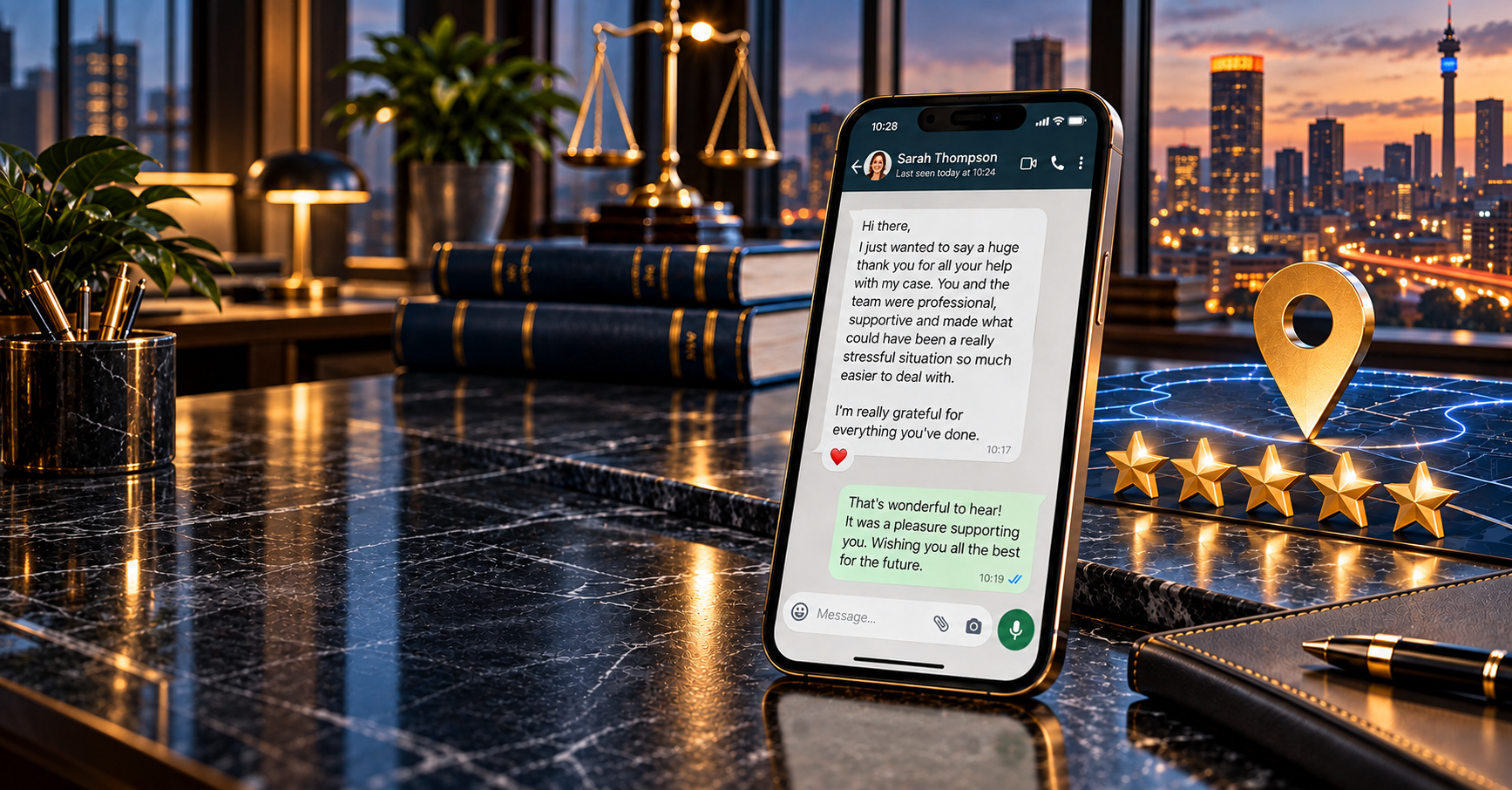
A law firm gets more Google reviews by asking every client, at the right moment, with a direct link, and by replying to every review without saying anything about the matter. That is the whole system. It is allowed under the LPC's rules, it costs nothing, and most firms still don't do it.
The firms that do it end up with 80 reviews while the firm next door has 11. Guess which one the next person calls.
Why do Google reviews matter so much for law firms?
Reviews are the first proof a stranger sees that your firm is real and treats people well. Google also uses them to decide which firms to show in the map results, and AI tools like ChatGPT read them when they suggest a lawyer. More recent, detailed reviews means more visibility and more calls.
Someone looking for an attorney in Polokwane or Pinetown sees three firms on the map and compares star ratings before reading a word on anyone's website. A 4.8 with 60 reviews beats a 5.0 with four.
Reviews also carry words. When a client writes "helped me with my late father's estate, explained everything in plain English," Google learns that your firm does estates. You could not buy that sentence.
Are law firms allowed to ask clients for reviews in South Africa?
Yes. Nothing in the LPC rules stops a client from posting an honest review, and nothing stops you from asking for one. The risk sits in what the firm says and does around the review: no payment, no fake reviews, no claims that mislead, and no confidential information in your replies.
LPC advertising rules let you market your practice as long as what you publish is accurate and doesn't mislead the public. A client's own words on Google are the client's words, not your advert. Where firms get into trouble is the extras:
- Paying or rewarding clients for reviews. A discount on the final account in exchange for five stars breaks Google's policy and looks bad in front of your professional body.
- Writing reviews yourself. Staff, family and the candidate attorney posting as "happy clients" is fake. Google removes them, often in batches, and sometimes suspends the profile.
- Only asking the happy ones. Filtering clients so only the satisfied get the link is called review gating. Google prohibits it. Ask everyone.
- Bragging in replies. "Thank you, we are the best divorce firm in Durban" is a claim you can't prove. Keep replies plain.
Treat a review request like any other client letter: accurate, polite, and nothing you'd mind reading aloud at a disciplinary hearing.
When is the best time to ask a client for a review?
Ask at the moment the client feels relief, which is usually the day the matter closes well. That might be the transfer registering, the divorce order being granted or the settlement landing in their account. Wait three weeks and the feeling fades, and so does the reply rate.
Most firms that ask at all ask in the final invoice email. That is the worst possible moment. The client is looking at a number, not a result.
Better moments we see working:
- The call where you give them the good news. End it with "Would you mind if I sent you a link to leave us a Google review?" Then send it within the hour.
- The day a conveyancing client gets their keys. They are happy and they have a story to tell.
The ask should come from the attorney who did the work, by name. A request from "Admin" gets ignored. A WhatsApp from the person who stood up for them in court gets answered.
What should the review request actually say?
Keep it to three lines: thank them by name, ask plainly, and give a link that opens the review box directly. No survey first, no star-rating form, no long story. Every extra step loses people who were happy to help.
Here is a message you can copy:
"Hi Thandi, thank you for trusting us with the house transfer. If you have two minutes, a short Google review would help other families find us: [link]. Thanks again, Pieter."
Get the direct link from your Google Business Profile under "Ask for reviews." Save it as a WhatsApp quick reply so nobody has to hunt for it. Never suggest words or a star rating.
How should a law firm reply to Google reviews?
Reply to every review within a few days, keep it short, and never confirm that the reviewer was a client or mention anything about their matter. Your duty of confidentiality does not switch off on Google. A warm, general thank-you is enough for positive reviews.
For a good review: "Thank you, we appreciate you taking the time. All the best from the team." That is all. Don't repeat their matter type back to them, even if they mentioned it.
For a bad review, the rule matters even more. You can't argue the facts in public, because the facts are privileged. Say something like: "We're sorry to read this. We take every concern seriously and would like to talk. Please call our office manager, Lindiwe, on the main number." Then take it offline and deal with it properly.
If a review is fake or from someone who was never a client, flag it for removal through your Business Profile. Don't respond with "we have no record of you." That still says something about who is and isn't on your books.
How many reviews does a law firm need to compete?
Enough to beat the firms around you on the map, and a steady trickle of new ones every month. In the towns we audit, the firms holding the top three map spots for "attorney near me" usually have dozens of reviews, and in the big metros often more than a hundred. Recency matters as much as the total.
A firm with 90 reviews where the latest is 14 months old looks closed. A firm with 40 reviews and two from last week looks busy. Aim for a few new reviews every month rather than a big push once a year.
To make that happen, give one person the job. Every closed matter goes on a short list. Every name on the list gets asked. At the monthly partners' meeting, look at two numbers: how many clients were asked, and how many reviews came in. Reward the asking, not the reviews.
For more on the profile those reviews sit on, read our guide to the page most firms don't know they're judged by.
Frequently asked questions
Can I offer a client a discount for leaving a review? No. Google treats any reward for a review as a policy breach, and it sits badly with the LPC's standards on honest marketing. Ask politely and let the client decide.
Should I ask clients whose matters did not go their way? Yes, if they were well served. Many clients who lost a case still value being kept informed and treated with respect. Asking everyone is also how you stay clear of review gating.
Can I reply to a review and mention the client's case? No. Keep every reply general. Confirming someone was a client, or referring to their matter, can breach your duty of confidentiality and POPIA.
What if a competitor leaves us a fake bad review? Flag it through your Google Business Profile and keep a record of why you believe it is fake. Reply once, briefly and politely, inviting the reviewer to contact the office.
The short version
Your past clients will sell your firm for you if you ask them at the right moment and make it easy. Ask everyone, reply to everyone, say nothing about the matter, and never pay for a review.
Want to see how your reviews stack up against the firms around you? Our free visibility audit compares your review count, rating and recency with your local competitors and shows you what it will take to pass them.
Written by
Brad McMahon
Ready to see where you stand?
Get your free Google Maps visibility audit for your firm. Delivered in 24 hours.
Get your free visibility audit →