
Why Your Firm is Losing the Local Pack and How to Win It Back
Want our law-firm growth insights surfaced first in your Google results? Make us a preferred source:
Add as a preferred source on Google
Your law firm is failing in the Local Pack because it uses generic 'LocalBusiness' schema that doesn't prove legal expertise. To win, you must implement specific 'LegalService' schema, using the 'knowsAbout' and 'areaServed' properties to create a verifiable architecture of authority that Google's algorithms reward.
There are two distinct battlegrounds in the fight for a potential client's attention: the Google Map Pack and the classic blue-link organic results. Most law firms are fighting this war with the wrong weapons. They deploy generic tactics, hoping for a victory on both fronts, yet end up invisible on the one that matters most for high-value local instructions.
The brutal truth is that your firm’s expertise is likely a complete black box to Google, and your competitors are taking advantage. It’s time to stop paying for digital noise and start building a verifiable architecture of authority.
The Invisible Tug-of-War: Local Pack vs Blue Links
Many marketing teams, and the partners who sign off on their budgets, fail to grasp a fundamental reality of search. The Google Local Pack, that coveted map-based block at the top of the results, does not play by the same rules as the ten blue links below it. They are driven by different algorithms, reward different signals, and ultimately, serve a different user intent. Winning in one does not guarantee victory in the other, and focusing on the wrong one is a systematic waste of resources.
The organic results are primarily a contest of content relevance and traditional authority signals. But the Local Pack is a battle for proven, geographically-bound expertise. Google’s algorithms are acting as sophisticated due diligence officers for users seeking immediate, local solutions. They aren’t just looking for ‘a lawyer’. They are searching for a prepared strategist in a specific jurisdiction to solve a specific problem.
A high ranking in the organic links for a blog post about contract law does little to convince the Map Pack algorithm that your Manchester office is the dominant force for commercial litigation in that city. They are separate and require a dedicated, technical approach.
Key Takeaway: The Google Local Pack and standard organic search results are driven by different algorithms, with the Local Pack rewarding signals of proven, local expertise.
LegalService Schema: The Foundation of Your Digital Identity
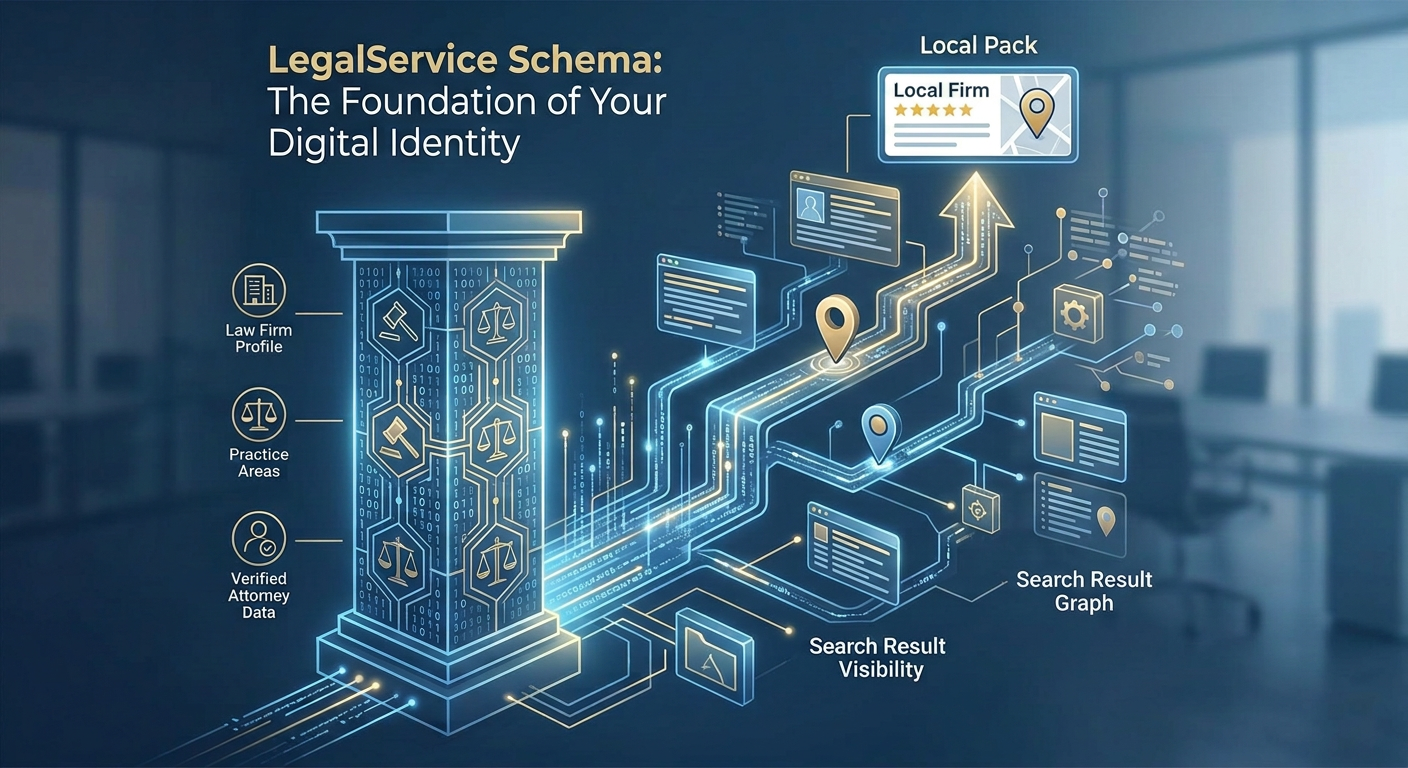
This is where most firms make their first, and most critical, error. They apply the standard 'LocalBusiness' schema to their website. This is a systematic mistake. This tag was designed for businesses like coffee shops, plumbers, and dry cleaners. It tells Google your name, your address, and your opening hours. It does nothing to communicate the depth of your legal expertise, the jurisdictions you serve, or the specific problems you solve. It treats your practice like a commodity.
To build a true architecture of authority, you must use the 'LegalService' schema type. This specialised vocabulary allows you to provide the granular, high-fidelity data points that Google’s modern algorithms require. Yet, even firms that use it consistently fail to use its most powerful properties. The 'knowsAbout' and 'areaServed' fields are routinely ignored. Without them, you are creating plenty of online presence, but with no real substance.
Populating the 'knowsAbout' field with your niche specialisms, like ‘High Court commercial litigation’ or ‘agricultural property disputes’, begins to build a verifiable trail of expert logic. It signals that you are a specialist, not a general practitioner. This is the first step in moving from being a black box of generic claims to a quantifiable reputation engine.
Key Takeaway: Firms must replace generic 'LocalBusiness' schema with the 'LegalService' type, using the 'knowsAbout' property to detail specific legal specialisms.
Mapping Your Practice: 'AreaServed' and its Impact on the Map Pack
For firms with multiple offices across different jurisdictions, improperly configured 'areaServed' schema is a source of digital fratricide. We frequently see a firm's Johannesburg office competing with its Cape Town team for the same enquiries. This happens because of lazy, broad-stroke implementation. A generic 'areaServed' tag that just says 'South Africa' is a liability.
You must move beyond this generic approach and implement a systematic architecture of authority for each office. The 'areaServed' property must be defined with granular jurisdictional insights. If your firm litigated in the Gauteng Local Division, the schema for your Johannesburg office must be isolated to that jurisdiction and specific postal codes. Implement a trust-verification layer where each location is defined by its own 'ServiceArea' using precise GeoShapes or specific PostalCode clusters. This ensures your teams aren't cannibalising each other's leads.
This level of architectural depth is non-negotiable. Firms failing to provide it will be priced out by 2026. Google's algorithms now act as due diligence officers and need high-fidelity data points to confirm your local dominance. Linking each office's schema to deconstructed analyses of local rulings or anonymised case data specific to that High Court division proves you're a prepared strategist in every jurisdiction where you operate. Without surfacing these granular insights, your metadata serves as a verifiable ledger of nothing.
Key Takeaway: Use the 'areaServed' property with precise geographic data for each office to prove local dominance and prevent internal competition for clients.
Building Authority Through the 'Person' Property

A law firm’s authority is not an abstract concept. It’s the direct result of the expertise held by the individuals within it. Yet, most attorney biographies on law firm websites are just static blocks of text. They are digital resumes, not active signals of authority. To bridge the gap between individual brilliance and firm-wide reputation, you must technically connect your people to your practice using nested 'Person' schema.
We suggest deploying a systematic architecture where 'Person' and 'Attorney' schema are nested within the main 'LegalService' entity. This creates a powerful, interconnected web of expertise that search engines can understand. Stop treating trial wins and accolades as simple text. Map them using the 'achievement' and 'award' properties.
But the real engine of authority is linking an individual’s specific 'knowsAbout' tags to granular jurisdictional insights. If a solicitor has deep experience in a particular tribunal or court, that must be documented in the code.
This transforms a simple biography into a critical component of your firm’s trust-verification layer. When Google's AI-driven systems crawl your site, they are performing other actions in addition to reading. They are auditing for expert logic. If they can programmatically connect a specific lawyer's documented experience in the Court of Appeal to the firm's overall 'LegalService' entity, you build a quantifiable and verifiable case for your expertise. This is how you start winning the clients you deserve.
Key Takeaway: Nest 'Person' and 'Attorney' schema within your 'LegalService' tag to connect individual solicitors' expertise directly to the firm's verifiable authority.
Common Pitfalls: When Your Schema Does More Harm Than Good
Partners often treat schema as a one-time, 'check-box' exercise. They hire a developer to implement basic tags and stop there, leaving the firm's true expertise locked in a black box. The primary mistake is not the volume of metadata. It is the profound lack of architectural depth.
You will not be penalised by Google for having 'too much' schema, provided that data is high-fidelity and verifiable. The real risk is producing meaningless, generic tags that fail to point to expert logic. This creates a facade of activity that lacks any substance. For example, listing 'Law' as a specialism under the 'knowsAbout' property is useless. It provides no signal of value to an algorithm.
In 2026, firms will be priced out of their markets if they do not provide a trust-verification layer that Large Language Models can audit. These AIs act as due diligence officers for potential clients. They search for outcome-based signals rather than a list of your office hours.
If your schema does not surface granular jurisdictional insights and connect them to your practitioners, you are paying for visibility without authority. You must transition from a generic web presence to a source of documented, verifiable expertise.
Key Takeaway: Avoid creating 'digital tumbleweed' by ensuring your schema has architectural depth with specific, high-fidelity data, rather than being a shallow, one-time exercise.
A Prioritised Checklist for Your Technical Team
To dominate your market, you must move beyond generic visibility and build documented authority. This is a series of systematic technical tasks. Deliver this prioritised checklist to your development or marketing team today.
- Replace all instances of 'LocalBusiness' schema with the 'LegalService' type. Standard business tags treat a practice like a dry cleaner. This foundational change ensures your architecture reflects a professional legal service.
- Populate the 'knowsAbout' property with granular jurisdictional insights. Avoid generic terms. Reference specific courts, such as the Supreme Court of Appeal in Bloemfontein, or deconstructed analyses of recent High Court rulings to signal expert logic.
- Define the 'areaServed' property for every office location using specific postal code clusters or GeoShape data. This prevents internal competition between offices and establishes local proximity authority for each team.
- Map every fee-earner using 'Person' and 'Attorney' schema nested within the firm's 'LegalService' tag. Link individual 'knowsAbout', 'awards', and 'memberOf' properties to turn a standard biography into a quantifiable reputation engine.
- Include outcome-based signals within your markup, such as anonymised settlement data or specific case types. Google's algorithms act as due diligence officers and require these high-fidelity data points to verify your standing.
- Validate every line of code to ensure it's error-free. Broken code results in digital tumbleweed. Clean data is required for generative engines to cite your firm as a prepared strategist.
Key Takeaway: Your technical team must replace 'LocalBusiness' with 'LegalService' schema, add specific 'knowsAbout' and 'areaServed' data, implement 'Person' schema, and validate the code.
Conclusion
The approach to search engine optimisation for law firms must change. It is no longer a game of keywords and backlinks. It is an exercise in building a systematic architecture of authority. Google's algorithms, and the AI summaries they now produce, function as diligent, evidence-seeking auditors. They are looking for a quantifiable trail of expert logic, and if you don't provide it, they will find a competitor who does.
Treating your website's structured data as a simple directory listing is a costly mistake. You must view it as a quantifiable reputation engine working 24/7 to prove your expertise. By implementing specialised legal schema with surgical precision, you move away from generic, low-fidelity metadata. This systematic approach ensures you become the definitive authority in your jurisdiction.
Key Definitions
Schema Markup
Code added to a website's backend to help search engines like Google understand the content, context, and relationships on a page in a structured way.
Local Pack
The box containing a map and 2-3 business listings that appears at the top of Google's search results for queries with local intent (e.g., 'solicitor near me').
LegalService Schema
A specific type of schema markup designed for law firms to define their services, areas of practice, jurisdictions served, and individual solicitors' expertise.
Architecture of Authority
A systematic, technical framework of structured data and content that proves a law firm's expertise, jurisdictional dominance, and reputation to search engines and clients.
Frequently Asked Questions
Why is my law firm not appearing in the Google Local Pack?
Your firm is likely invisible because it uses generic 'LocalBusiness' schema, which fails to communicate your legal expertise. The Local Pack algorithm requires specialised 'LegalService' schema to verify your authority within a specific jurisdiction.
What is 'LegalService' schema?
It is a specialised type of structured data that allows a law firm to communicate its unique legal specialisms, jurisdictions, and practitioner expertise to search engines. This builds a verifiable architecture of authority that goes far beyond a simple business listing.
How can I improve my firm's ranking for multiple office locations?
Define the 'areaServed' property with precise geographic data, like postcodes or GeoShapes, for each office. This signals local dominance to Google for each location and prevents your own offices from competing against each other for the same enquiries.
What is the biggest mistake firms make with schema markup?
The most common error is treating schema as a simple, one-off technical task and using shallow, generic tags. This creates an online presence that has visibility, but no verifiable proof of expertise, making it ineffective.
How does 'Person' schema benefit a law firm's SEO?
By nesting 'Person' schema within the main 'LegalService' tag for each solicitor, you technically link their individual experience and specialisms to the firm's authority. This transforms a simple biography into a dynamic, authority-building asset that search engines can audit.
Keywords: Legal SEO, Schema Markup, Local SEO, E-E-A-T, Law Firm Marketing, JSON-LD
Written by
Brad McMahon
Ready to see where you stand?
Get your free Google Maps visibility audit for your firm. Delivered in 24 hours.
Get your free visibility audit →