
Why your law firm's online listings are probably wrong
Want our law-firm growth insights surfaced first in your Google results? Make us a preferred source:
Add as a preferred source on Google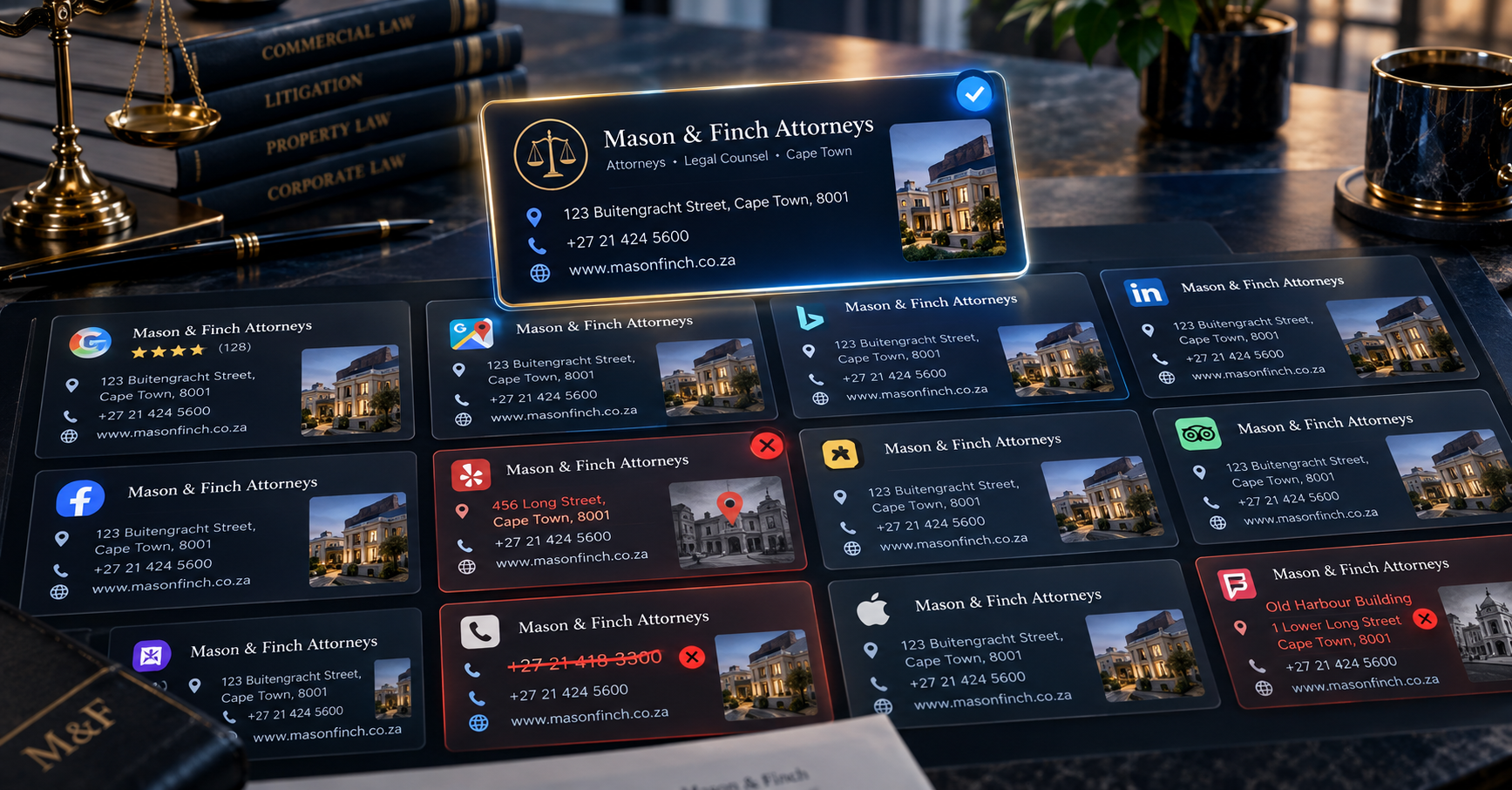
Your law firm is almost certainly listed on dozens of websites you have never visited, and some of those listings are wrong. An old phone number, the office you left in 2019, a partner who retired. Google and AI tools notice those mismatches, trust your firm a little less, and show the firm down the road instead.
The fix is boring and it works. Find every listing, correct the details to match one master version, and check them twice a year.
What is a business citation for a law firm?
A citation is any place online that mentions your firm's name, address and phone number together. Google Maps, Facebook, Brabys, Cylex, Apple Maps, Bing, LinkedIn and legal directories all count. Google reads them as outside proof that your firm exists where it says it does.
Think of it like references on a CV. One good reference is fine. Ten references that all describe the same person are better. But if three of them give a different surname and a different town, the employer starts to wonder.
Most firms never created most of their listings. Directories scrape data from company registrations, old websites and each other. So a listing can exist, carry your name, and be wrong without anyone at the firm ever having touched it.
Why do wrong listings hurt your Google ranking?
Google wants to send people to a business it is confident about. When your details disagree from one site to the next, that confidence drops, and so does your position in the map results. The firm with clean, matching details often ranks above a bigger firm with messy ones.
There is a second cost that has nothing to do with rankings. A potential client finds your old number on a directory, phones it, and gets a disconnected line or, worse, another business. They do not try again. They call the next firm on the list.
We see this pattern in towns across the country. A firm moves from a house in Menlo Park to an office park in Pretoria East, updates its website and its Google profile, and forgets the rest. Two years later half the web still sends people to the old house.
Do AI tools like ChatGPT use directory listings?
Yes. AI assistants build their picture of a business from many sources at once, and directories are a large part of that picture. When the sources agree, the AI can describe your firm with confidence. When they disagree, it is more likely to leave you out or give the wrong details.
Ask ChatGPT for a family law attorney in Bloemfontein and it does not phone around. It pulls from what is published. If one site says you are in Westdene, another says Brandwag and a third lists a number that rings a dentist, you are a risky answer. Risky answers tend not to get named.
Which directories matter most for South African law firms?
Start with the big platforms, then the SA business directories, then anything legal-specific. Google Business Profile comes first by a long way. After that: Apple Maps, Bing Places, Facebook, LinkedIn, Brabys, Cylex and Hotfrog, plus any legal directory or association listing your firm appears on.
A sensible order to work through:
- The platforms people search on directly. Google, Apple Maps and Bing Places. These power the maps on phones, in cars and inside other apps.
- Social profiles. Facebook and LinkedIn company pages. Clients check these to see if a firm is active.
- SA business directories. Brabys, Cylex, Hotfrog, Yep and similar sites. Many people never visit them, but Google and AI tools do.
- Legal and professional listings. Your local law society's attorney search, bar or association pages, and any paid legal directory you once signed up for.
Do not chase hundreds of tiny directories. Clean, matching details on the ones that matter beat a scattering of half-finished profiles on sites nobody reads.
How do I find out where my firm is listed wrong?
Search for your firm the way a stranger would, and keep a spreadsheet. Search your firm name, your old phone numbers and your old addresses on Google. Every result that shows outdated details goes on the list with the link and what needs to change.
Searching your old phone number is the trick most firms miss. It turns up listings that no longer carry your current name, which a name search will never find. Do the same with any former street address and any partner who has left.
You can also pay for a listing tool that scans the main directories for you. These are useful for speed, but they rarely cover the smaller SA sites well, so a manual search is still worth an hour of someone's time.
How do I fix incorrect law firm listings?
Write down one master version of your details, then make every listing match it exactly. Claim each listing using the site's own "claim this business" or "suggest an edit" option, correct it, and record the date. Where you cannot claim a listing, report it and ask for removal.
Your master version should settle the small choices once:
1. The firm name exactly as it appears on your letterhead. No added keywords like "Best Divorce Lawyers".
2. The street address written the same way every time, including the unit number and suite.
3. One main phone number, ideally a landline or a number that will never change when staff do.
4. Your website address, with or without "www", but always the same.
5. Business hours and the main practice areas you want to be known for.
Small differences count. "Suite 4, 12 Main Road" on one site and "12 Main Rd, Unit 4" on another look like two different places to a computer. Pick one and copy-paste it everywhere.
Expect some sites to take weeks to update. Note it, move on, and check again next month.
How often should a law firm check its listings?
Check your main listings every six months and after any change at the firm. A new phone system, a move, a new partner or a closed branch should trigger a full sweep that same week. Directories pick up old data again over time, so this is maintenance, not a once-off job.
Put the sweep on the calendar the same way you would diarise a prescription date. It takes a couple of hours if the records are good. It takes days if nobody has looked since the firm was founded.
Frequently asked questions
Is it worth paying for a listing management service? It can save time if your firm has several offices or has moved often. For a single-office firm, one careful manual clean-up plus a check every six months is usually enough.
Should I delete duplicate Google listings? Yes, but merge or remove them through Google's own process rather than ignoring them. Two profiles for one firm split your reviews and confuse Google about which one to show.
Will fixing listings get my firm to the top of Google Maps? On its own, no. Clean listings remove a drag on your ranking. You still need a strong Google Business Profile, steady reviews and a proper website to climb.
Can I list my firm at a virtual office address? Google's rules require a real location where you meet clients or a service area with the address hidden. A shared-office address you never use risks suspension.
The short version
Your firm's details are scattered across the web, and some of them are wrong. Find them, correct them to one master version, and check twice a year. It is one of the cheapest ranking fixes there is. You can see how this fits into the rest of the system on our how it works page.
Want to know where your firm is listed wrong? Our free visibility audit checks your listings against your Google profile and shows you exactly which ones need fixing.
Written by
Brad McMahon
Ready to see where you stand?
Get your free Google Maps visibility audit for your firm. Delivered in 24 hours.
Get your free visibility audit →