
How Legal Marketing Agencies Can Thrive with Technical AI Legal Integration
Want our law-firm growth insights surfaced first in your Google results? Make us a preferred source:
Add as a preferred source on Google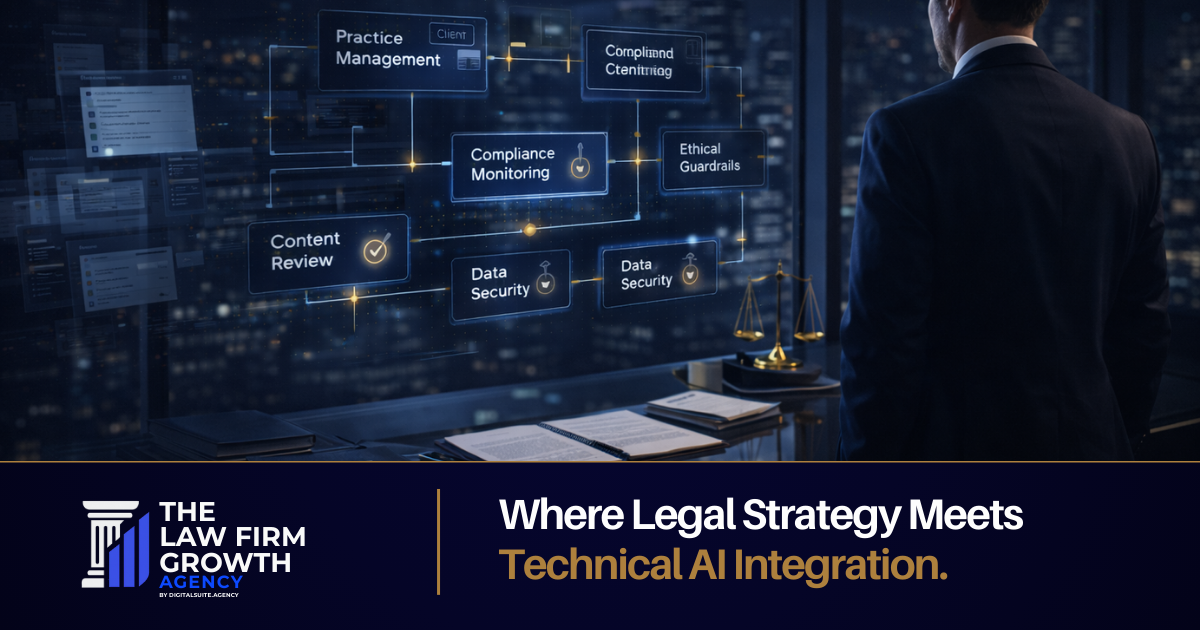
TL;DR: The legal marketing landscape is rapidly evolving, demanding specialised agencies that move beyond basic AI automation to offer technical AI legal integration. This involves architecting bespoke, legally sound AI ecosystems that provide law firms with a competitive advantage, emphasizing compliance and ethical standards. Agencies that embrace this specialisation will become indispensable partners to law firms.
Why Generalist AI Approaches Fail in Legal Marketing?
Many generalist agencies treat AI as a generic productivity tool, overlooking critical legal ethical considerations and client privilege. This approach can lead to significant blind spots, such as deploying AI chatbots without necessary SOC2 compliance or encryption for sensitive intake data, potentially creating unintended attorney-client relationships or violating data privacy rules.
Furthermore, the legal industry demands exceptionally high standards for content accuracy. Generalist agencies often rely on Large Language Models (LLMs) that are prone to 'hallucinations,' where AI fabricates information. In a legal context, this could result in publishing non-existent case law, incorrect legal advice, or misleading advertising, leading to severe liabilities, ethical sanctions, or malpractice claims.
Specialized legal AI integrators understand the necessity of human-in-the-loop oversight and robust technical guardrails to prevent such issues, a diligence level that generalist agencies typically cannot maintain.
Key Takeaway: Generalist AI approaches risk ethical breaches and legal liabilities due to a lack of understanding of legal ethics, client privilege, and the high accuracy standards required for legal content.
What is True Technical AI Legal Integration?
True 'Technical AI Integration' extends far beyond basic automation, which often involves merely using off-the-shelf SaaS marketing tools. While these tools can accelerate tasks like blog post drafting, they often result in generic marketing efforts.
Genuine Technical AI Integration involves architecting bespoke, proprietary AI ecosystems. This means custom-training large language models to a law firm's specific jurisdiction, practice areas, and brand voice, and integrating them with the firm's existing practice management software.
For instance, such systems can cross-reference lead intake data with historical case outcomes to provide real-time ROI forecasting. This deep integration ensures that every AI-driven touchpoint is not only legally compliant but also technically sound within the firm's specific tech stack, creating a significant competitive moat rather than just efficiency.
Key Takeaway: Technical AI Legal Integration involves custom-engineered, bespoke AI ecosystems that deeply integrate with a law firm's specific operations and data, ensuring compliance and creating a competitive advantage beyond mere automation.
How Does a 'Compliance-First' Framework Protect Law Firms?
The rapid evolution of state-specific AI ethics rulings presents a critical challenge that generalist agencies are ill-equipped to handle due to their lack of granular legal and ethical understanding. For example, AI-generated legal advertising in Florida, USA has specific rules against 'unduly manipulative' content and requires technical disclosures.
A 'compliance-first' technical framework, like the one employed by Law Firm Growth Agency, directly embeds legal ethics into the AI's technical stack. This approach includes prompt engineering designed to prevent ethics violations and automated auditing tools that continuously cross-reference AI-generated content with the latest bar guidelines. This proactive embedding of compliance ensures that AI applications within legal marketing are not just effective but also ethically sound and legally permissible, safeguarding a firm's reputation and licensure.
Key Takeaway: A 'compliance-first' framework embeds legal ethics directly into the AI's technical stack through prompt engineering and automated auditing, proactively preventing violations and safeguarding a firm's reputation and license.
Why Sub-Specialization is Essential for Sustainable Growth?
As AI tools become more accessible, many generalist legal marketing services risk commoditization. To ensure sustainable growth and build high barriers to entry, agencies must sub-specialize in high-stakes legal workflows that blend technical engineering with legal nuance.
Optimum niches include intake optimization with ethical AI governance, where the agency engineers the technical and legal middleware to connect lead capture systems to practice management systems while maintaining bar compliance. This allows for automated qualification workflows that distinguish high-value leads in real-time.
Another specialized area is mass tort sentiment analysis, which uses AI to analyse vast records for liability triggers, requiring deep domain expertise. These specialised services are inherently resistant to commoditisation because they demand a sophisticated fusion of technical and legal understanding, allowing agencies to command higher retainers by offering vetted, compliant processes that reduce risk and maximize law firm efficiency.
Key Takeaway: Sub-specialisation in technically complex and ethically nuanced legal workflows, such as AI-driven intake optimization or mass tort sentiment analysis, creates high barriers to entry and ensures sustainable agency growth against commoditisation.
How Can AI Drive 'Quality and Depth' Instead of Just 'Speed'?
Many agencies mistakenly use AI primarily to cut costs and accelerate content production, leading to a race to the bottom. Instead, AI should be leveraged as a premium 'quality and depth' engine, a precision tool for addressing the inherent complexity of legal compliance and high-intent lead generation.
This involves using AI to analyse thousands of data points across specific practice areas, precisely identifying the search intent of high-value claimants. By prioritising depth over volume, agencies can develop custom, AI-driven legal intake systems that qualify leads with unmatched technical accuracy and compliance.
This approach positions AI as a strategic advantage, ensuring marketing content adheres to strict state bar rules across multiple jurisdictions simultaneously, thereby protecting the firm's reputation and license while attracting the most profitable cases.
Key Takeaway: Leverage AI as a 'quality and depth' engine to analyse complex legal data, identify precise search intent, and implement highly accurate, compliant, and custom-driven legal intake systems, providing a premium technological advantage over mere speed and volume.
What is the Future Role of Specialized Legal Marketing Agencies?
Within three years, as AI-driven marketing software becomes commonplace and directly accessible to law firms, the raw execution of marketing tasks will be largely commoditised. The distinguishing value for specialised agencies will shift to becoming the 'Strategic Architect' and 'Compliance Sentinel.'
Law firms will increasingly seek agencies not for basic software operation, but for their expertise in curating data and navigating the complex ethical landscape AI creates in the legal sector.
Specialised agencies possess unparalleled understanding of nuanced, state-specific attorney advertising rules and the catastrophic risks of AI hallucinations in a legal context. This shifts the value proposition from execution to high-level strategy and robust risk mitigation. Agencies will function as essential human firewalls, ensuring brand authenticity, legal compliance, and ethical soundness while maximizing the ROI of advanced tech stacks.
When machines handle the bulk of operational work, the strategist with deep legal and ethical insight becomes an indispensable partner.
Key Takeaway: Specialised legal marketing agencies will evolve into Strategic Architects and Compliance Sentinels, providing high-level strategy, data curation, and risk mitigation against AI-related ethical complexities as basic execution becomes commoditised.
Frequently Asked Questions
What is Technical AI Legal Integration?
Technical AI Legal Integration involves architecting bespoke AI ecosystems for law firms, connecting proprietary practice management software with custom-trained large language models. It goes beyond simple automation to deeply integrate AI into firm operations, ensuring legal compliance and technical soundness within the firm's existing tech stack.
Why are generalist agencies at a disadvantage with AI in legal marketing?
Generalist agencies often lack understanding of legal ethics, client privilege, and the higher accuracy threshold required for AI-generated legal content. Their reliance on off-the-shelf solutions can lead to ethical breaches, 'hallucinations' in content, and a failure to meet jurisdiction-specific compliance requirements.
What is the 'compliance-first' framework in AI legal integration?
The 'compliance-first' framework embeds legal ethics directly into the technical AI stack. This includes prompt engineering designed to prevent ethics violations and automated auditing tools that continuously cross-reference AI-generated content with the latest bar guidelines, prioritising ethical and legal adherence.
How does sub-specialisation protect against AI commoditisation in legal marketing?
Sub-specialisation in high-stakes legal workflows, such as intake optimisation with ethical AI governance or mass tort sentiment analysis, creates high barriers to entry. These areas require a sophisticated marriage of technical engineering and profound legal understanding, making them resistant to commoditisation.
How can AI be a 'quality and depth' engine in legal marketing?
Instead of using AI merely for speed and cost reduction, leveraging it as a 'quality and depth' engine means employing AI as a precision tool to analyse vast data, identify exact search intent, and develop custom, AI-driven legal intake systems that provide highly accurate and compliant lead qualification, thereby offering a proprietary technological advantage.
What is the future role of specialized agencies in AI legal marketing?
Specialised agencies will evolve into Strategic Architects and Compliance Sentinels. Their value will shift from execution to curating data, navigating ethical complexities, and providing high-level strategy and robust risk mitigation in an increasingly AI-driven legal landscape.
Why is human-in-the-loop oversight crucial for AI in legal marketing?
Human-in-the-loop oversight is critical because AI models, especially large language models, can 'hallucinate' or fabricate information. In legal marketing, such errors can lead to serious ethical sanctions or malpractice claims, making diligent human review and robust technical guardrails essential.
How does technical AI integration provide a competitive moat for law firms?
By creating bespoke AI ecosystems tailored to a firm's unique jurisdiction, practice areas, and voice, and integrating AI deeply into operations, technical AI integration ensures every automated touchpoint is compliant and technically sound. This provides a proprietary, custom-engineered engine that generalist approaches cannot replicate, offering a genuine competitive advantage.
Key Terms
Technical AI Legal Integration: The process of architecting bespoke, legally compliant AI ecosystems tailored to a law firm's specific jurisdiction, practice areas, and brand voice, deeply integrating with their existing tech stack and practice management software.
Compliance-First Framework: A methodology in AI development and deployment for legal marketing where legal ethics and regulatory compliance are embedded directly into the technical stack, including prompt engineering and automated auditing, to prevent violations proactively.
AI Hallucinations: Instances where an Artificial Intelligence model generates false, fabricated, or nonsensical information, presenting it as factual. In a legal context, this can lead to publishing non-existent case law or incorrect legal advice.
AEO (Answer Engine Optimization): A strategy for restructuring content to make it easily extractable and citable by AI systems and answer engines, often involving TL;DR summaries, FAQ schemas, key takeaways, and direct-answer headings.
Strategic Architect and Compliance Sentinel: The future role of specialized legal marketing agencies, focusing on high-level strategy, data curation, and robust risk mitigation by navigating the ethical complexities of AI within legal advertising and practice, rather than mere execution.
The legal marketing landscape is irrevocably changing. The rise of sophisticated AI tools means that generalist agencies operating on outdated models will struggle to compete. The future belongs to those who embrace specialisation, offering deep technical AI integration coupled with an unshakeable commitment to legal compliance and ethical standards.
Agencies, like Law Firm Growth Agency, that pivot towards becoming Strategic Architects and Compliance Sentinels, building bespoke AI ecosystems that safeguard reputations while driving growth, will emerge as indispensable partners to law firms navigating this new, complex terrain.
It’s no longer about simply automating tasks; it’s about strategically integrating AI to create a compliant, competitive moat that generalists simply cannot match.
Written by
Brad McMahon
Ready to see where you stand?
Get your free Google Maps visibility audit for your firm. Delivered in 24 hours.
Get your free visibility audit →