
How Law Firms Can Build an Authority Engine to Protect Against AI Hallucinations
Want our law-firm growth insights surfaced first in your Google results? Make us a preferred source:
Add as a preferred source on Google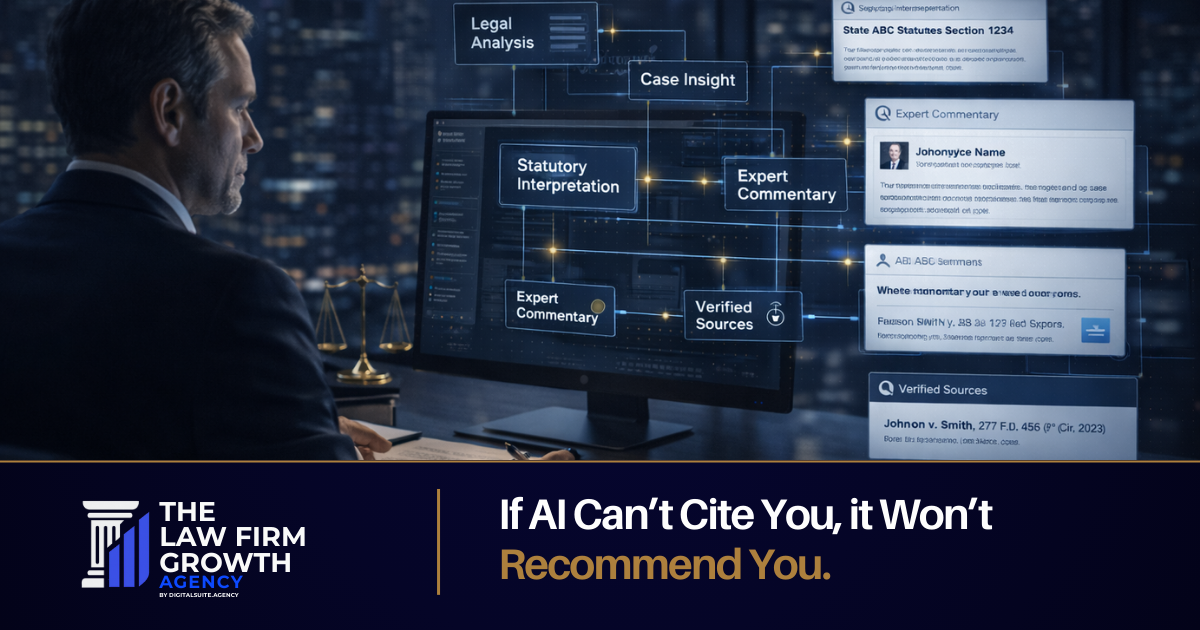
TL;DR: In an AI-driven digital landscape, law firms must evolve beyond traditional websites to become 'Authority Engines' by providing citation-ready, expert-led content. This strategic shift involves leveraging structured data, unique insights, and proprietary case reflections to establish the firm as a primary, trusted source for AI systems. By doing so, law firms can protect their reputation from AI hallucinations and ensure unparalleled discoverability and trust in the rapidly changing digital legal sphere.
What is an Authority Engine, and How Does it Differ from a Traditional Law Firm Website?
At Law Firm Growth Agency, we've observed a profound shift in how the most successful law firms are structuring their online presence. The traditional brochure site, with its static pages and generic information, is rapidly becoming obsolete. In its place, the Authority Engine emerges—a dynamic, intrinsically linked digital ecosystem designed not just for human visitors, but for the discerning algorithms of AI agents.
The fundamental difference lies in its technical and structural hallmarks. A traditional site might list a lawyer's name; an Authority Engine, however, employs a robust structured data foundation, leveraging advanced Schema markup to map intricate relationships.
We aren't just tagging a lawyer as a person; we're meticulously detailing their specific legal expertise, their pertinent case results, the precise jurisdictions they serve, and their authored insights. This meticulous data mapping creates a comprehensive knowledge graph that both AI agents and sophisticated search engines can not only digest but crucially, understand and trust.
Structurally, this translates into a move away from vague, catch-all practice area pages. Instead of a single page vaguely touching upon various aspects, an Authority Engine features hyper-focused, deep-dive content that precisely answers specific legal queries.
Key Takeaway: An Authority Engine transforms a law firm's online presence into a dynamic, AI-digestible ecosystem using structured data and detailed information beyond generic listings.
How Can Law Firms Create Citation-Ready Content for AI Systems?
In the emerging landscape of AI-driven search, generic legal summaries are no longer enough. To transition from a mere digital brochure to a true Authority Engine, your content must be what we term citation-ready. At Law Firm Growth Agency, we're seeing a massive shift in how AI agents like Perplexity and SearchGPT vet legal content, prioritizing depth and uniqueness over surface-level platitudes.
The hallmark of citation-ready content is the inclusion of proprietary datasets or unique case reflections. AI models, by their very nature, are trained on the vast but generalized expanse of the internet. When your firm provides specific, localised data, a nuanced breakdown of a recent niche ruling, or insights gleaned from years of specific litigation, you're offering the unique, verifiable information that AI agents can cite directly, establishing your firm as the definitive primary source.
Key Takeaway: To be citation-ready, law firm content must offer proprietary datasets, unique case reflections, and specific, localized insights that AI can directly cite.
How Does an Authority Engine Act as a Reputation Shield Against AI Hallucinations?
The rise of AI presents a new frontier in reputation management for law firms. In the bygone era of traditional search, a law firm's online reputation was primarily managed through review sites and targeted SEO. However, with AI agents increasingly synthesising information and answering user queries directly, the risk of AI 'hallucinations'—where AI generates misleading or incorrect information—becomes a significant concern.
An Authority Engine mitigates this risk by providing AI systems with an abundance of verifiable, high-fidelity, and uniquely sourced content. When your firm is the original source of proprietary data, detailed legal analysis, and specific case outcomes, AI agents are far more likely to extract and cite accurate information directly from your site.
This structured expertise acts as a fortified barrier, ensuring that when AI answers questions related to your legal domain, it draws upon your vetted and authoritative content, thereby protecting your firm's reputation from the inaccuracies that can arise from general AI browsing.
Key Takeaway: An Authority Engine protects a law firm's reputation by providing AI systems with verifiable, proprietary content, minimizing the risk of AI-generated misinformation or 'hallucinations.'
How Should Law Firms Measure Authority in a Zero-Click, AI-Dominated World?
For many law firms, the enduring pursuit of keywords and top-of-funnel traffic remains a primary marketing objective. However, at Law Firm Growth Agency, we're seeing a massive shift in how legal marketing converts. If your firm is still obsessing over raw click counts and site visitors, you're playing a game that is rapidly becoming obsolete. The modern digital landscape, increasingly dominated by AI-driven search, means users are often getting their questions answered directly on the results page—without ever clicking through to a website.
This makes chasing human clicks a potentially losing strategy. In a zero-click world, a high-traffic strategy fails when a potential client obtains their legal answer from an AI agent without ever interacting with your link. Clicks do not inherently equate to trust, and in an environment where AI models mediate the client journey, visibility for these AI models matters infinitely more than a visit to your homepage.
We advise our clients to abandon vanity metrics and instead focus on measuring organic brand mentions and entity authority. The new gold standard isn't how many people click your link, but how often your firm is cited as the definitive source by AI agents. We emphasize tracking conversion rates from high-intent, qualified leads—the kind that emerge once an AI has already vetted and recommended your firm—rather than simply total site visitors. The ultimate goal is to become the trusted information source that AI tools instinctively rely on.
By pivoting from a digital brochure to an Authority Engine, your firm isn't just hunting for fleeting clicks; it's cementing its position as the undisputed expert that both AI systems and humans feel compelled to trust, ensuring sustainability and unparalleled discoverability in this new digital era.
Key Takeaway: In a zero-click, AI-dominated world, law firms should prioritize measuring organic brand mentions and entity authority—how often AI cites them as a definitive source—over traditional website clicks.
What is the Inevitable Authority Gap, and Why is Acting Now Crucial for Law Firms?
In three to five years, the dichotomy between law firms that embrace the Authority Engine model and those clinging to traditional content marketing will not merely be a matter of differing traffic numbers; it will be a differential in existence. At Law Firm Growth Agency, we are witnessing the live, real-time demise of the digital brochure. Firms that persist in traditional content marketing—surface-level blogs, generic advice written primarily for keyword ranking—will find themselves utterly invisible to the sophisticated AI agents that increasingly mediate the crucial client journey.
The Authority Gap will manifest as a fundamental and irreversible loss of brand equity. Law firms that proactively build Authority Engines will have cultivated a formidable, moated ecosystem of proprietary data, deep-dive video insights, and robustly structured entities. This rich, verified knowledge base will earn the unwavering trust of cutting-edge AI models like Perplexity and ChatGPT. Consequently, when a prospective client queries an AI for a specific legal recommendation, these high-authority firms will be the sole ones cited and presented as definitive sources.
Conversely, firms that fail to transition will be relegated to the digital noise—an undifferentiated mass fighting desperately for low-intent, residual clicks. While these laggards vie for scraps, the Authority Engines will be capturing the premium, high-trust cases long before a human ever types a single search query.
Within five short years, the imperative is clear: if your firm isn't actively feeding the machines with high-signal expertise, you simply won't be part of the critical legal conversation. The Authority Gap, then, becomes binary: you are either the undisputed, verified expert within the AI's knowledge base, or you are, to all intents and purposes, invisible. The time to act decisively is now.
Key Takeaway: The 'Authority Gap' will lead to an irreversible loss of brand equity for law firms that fail to adopt an Authority Engine, making them invisible to AI-mediated client journeys and losing out on high-trust cases.
What Common AI Content Mistakes Should Law Firms Actively Avoid?
While AI presents incredible opportunities for content generation, its misuse can actively undermine a law firm's authority, making them more susceptible to misrepresentation by AI agents. At Law Firm Growth Agency, we observe a dangerous trend where firms treat AI as a mere vending machine for generic content, a practice that leads to significant pitfalls.
The biggest mistake we identify is the publication of what we call vanilla legal summaries. When firms leverage AI to churn out dry, high-level overviews of practice areas like personal injury law or estate planning, they are inadvertently training AI agents to view their firm as a commodity. Modern AI agents, the very ones now powering sophisticated search functionalities, prioritise unique insights, proprietary data, and nuanced legal opinions. If your firm’s website content reads like a basic Wikipedia entry—devoid of specific applications or unique perspectives—you are essentially creating no informational moat around your expertise.
Another critical error is the discernible lack of a human feedback loop. Many firms generate AI content and then publish it without sufficiently injecting their specific case wins, detailing their unique firm philosophy, or weaving in localised expertise and real-world results. This omission critically undermines authority because AI agents are actively seeking entities with verifiable, real-world experience.
Providing generic advice makes it highly probable that an AI assistant like ChatGPT or Perplexity will either misrepresent your actual capabilities or, worse, fail to cite you altogether because you offered nothing original or distinctive. To truly build an Authority Engine, the strategic imperative is to use AI to amplify your unique legal voice, not to replace it with a generic one. If the content could plausibly be claimed by any other law firm in your zip code, it is actively detracting from your distinct brand and diminishing your perceived authority in the eyes of advanced AI systems.
Key Takeaway: Law firms must avoid publishing generic AI-generated 'vanilla legal summaries' and ensure a human feedback loop to inject unique case wins and firm philosophy, preventing being seen as a commodity by AI.
Frequently Asked Questions
What is an Authority Engine for law firms?
An Authority Engine is a dynamic, intrinsically linked digital ecosystem designed for law firms that uses robust structured data and unique, citation-ready content to establish itself as a trusted primary source for AI agents and sophisticated search engines.
Why is citation-ready content important for law firms?
Citation-ready content is crucial because AI models like Perplexity and SearchGPT prioritise depth and uniqueness. By providing specific, localised data, nuanced legal breakdowns, or insights from specific litigation, law firms offer proprietary information that AI agents can cite, preventing hallucinations and establishing expertise.
How do AI hallucinations impact law firms?
AI hallucinations can present a new frontier in reputation management, as AI systems might misrepresent a firm's capabilities or fail to cite them if their content is generic. Building an Authority Engine with verifiable, expert-led content acts as a shield against such misinformation.
How should law firms measure success in an AI-driven, zero-click world?
Law firms should shift from vanity metrics like raw click counts to measuring organic brand mentions and entity authority. Success is defined by how often the firm is cited as a definitive source by AI agents and conversion rates from high-intent, qualified leads vetted by AI.
What are common AI content mistakes law firms should avoid?
Law firms should avoid publishing 'vanilla legal summaries' generated by AI without unique insights or a human feedback loop. Generic content without specific case wins, firm philosophy, or localised expertise fails to create an informational moat and can lead to misrepresentation by AI.
What is the 'Authority Gap'?
The 'Authority Gap' refers to the widening disparity between law firms that embrace the Authority Engine model and those that do not. Firms with Authority Engines will be cited as definitive sources by AI, while those relying on traditional content will become invisible to AI-mediated client journeys.
Key Terms
Authority Engine: A dynamic, intrinsically linked digital ecosystem for law firms, designed with robust structured data and citation-ready content, to become a primary, trusted source for AI agents and sophisticated search engines.
Citation-Ready Content: Legal content that includes proprietary datasets, unique case reflections, specific localised data, or nuanced insights from litigation, enabling AI agents to directly extract and cite it as an authoritative source.
AI Hallucinations: Instances where AI models generate misleading, incorrect, or fabricated information, especially when synthesising general internet data, which can negatively impact a law firm's reputation if not counteracted by authoritative content.
Zero-Click World: A digital landscape where users often get their questions answered directly on search engine results pages by AI agents, reducing the need to click through to websites and shifting the focus from website traffic to AI citability.
Authority Gap: The growing divide between law firms that proactively build 'Authority Engines' and those that do not, resulting in an irreversible loss of brand equity and visibility for firms clinging to traditional content marketing, making them invisible to AI-mediated client journeys.
The digital landscape for law firms is at an inflection point. The transition from a static digital brochure to a dynamic Authority Engine is no longer a strategic option but a critical imperative. As AI increasingly mediates how potential clients discover and vet legal services, your firm's ability to provide citation-ready, expert-led content determines its very visibility and reputation.
By embracing structured data, cultivating proprietary insights, and strategically extracting the deep knowledge of your partners, you build an unshakeable shield against misinformation and cement your firm as the undeniable authority in its field. The future of law firm growth hinges on becoming the trusted source that AI systems and humans alike turn to for high-fidelity legal expertise.
Don't be left behind in the rapidly widening 'Authority Gap'; build your Authority Engine today and secure your firm's legacy in the post-search world.
Tags: Law Firm Marketing, AI in Legal, Authority Engine, Content Marketing, Legal SEO, AI Hallucinations, Citation-Ready Content, Structured Data for Law Firms
Written by
Brad McMahon
Ready to see where you stand?
Get your free Google Maps visibility audit for your firm. Delivered in 24 hours.
Get your free visibility audit →