
How AI picks which law firm to recommend
Want our law-firm growth insights surfaced first in your Google results? Make us a preferred source:
Add as a preferred source on Google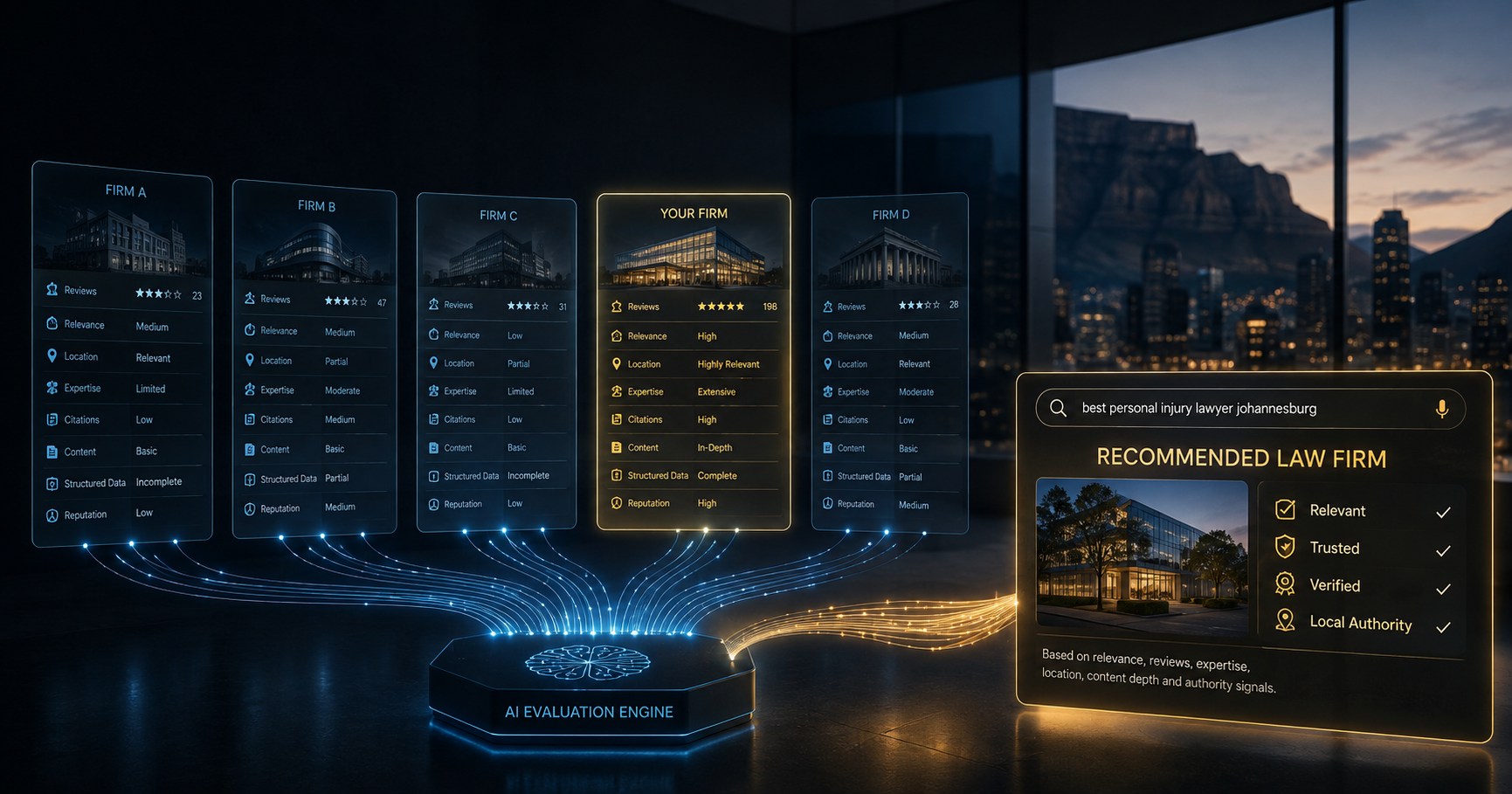
AI answer engines recommend the law firms they can verify. Three signals decide who gets named: your details match everywhere, your website says plainly what you do and where, and you publish content worth quoting. If your firm is one of those names, you get the call. If it isn't, you don't exist.
Here is what that looks like in practice. A prospective client with a retrenchment dispute types into her phone: "who are the best labour attorneys in Sandton?" Two years ago that question went to Google and came back as ten blue links. Today it often goes to ChatGPT, Google's AI Overviews, Gemini or Perplexity — and the answer comes back as three or four firm names in a paragraph. No list. No page two.
Why does AI search matter for a small law firm?
Because the firms AI names get the first call, and AI only names firms it can read about. Search results rewarded being on the page. AI answers reward being named in the answer. A different game, and most small firms are not playing it yet.
It matters most for the firms with the least marketing muscle. South Africa has roughly 33,929 practising attorneys, according to the Law Society of South Africa's 2025 profession statistics. About 18,000 of them practise alone or in firms of fewer than ten. The big names get mentioned by AI because they are written about everywhere: press coverage, directories, reported judgments. A five-attorney practice in Bellville or Umhlanga has none of that gravity. If an AI model has nothing consistent to read about you, it will not invent you. It will name a competitor it can read about.
How do AI answer engines choose which law firms to name?
They do not rank pages the way search engines do. They assemble answers from sources that look consistent and corroborated. Across our audits of small firms, three signals decide whether you get named.
1. Consistency of the basics
Your firm's name, address, phone number and practice areas must match everywhere: your website, your Google Business Profile, legal directories, LSSA and provincial society listings, your social profiles. A model that finds three addresses and two phone numbers for one firm treats that firm as unreliable data. Most firms fail here, usually because of an office move or a number that changed years ago and was never chased down.
2. Entity clarity
Your website must say, in plain language a machine can parse, what you do, for whom, and where. "We offer a full spectrum of legal services" tells a model nothing. "We act for employees and employers in CCMA arbitrations and Labour Court matters in Gauteng" tells it exactly when to name you. Our rule of thumb: if a bright candidate attorney could not summarise your specialisation from your homepage in one sentence, neither can a model. (This is exactly what our AI visibility work fixes.)
3. Substance
Answer engines quote sources that explain things. A firm that publishes clear, accurate pieces (what happens at a section 189 consultation, how long a Road Accident Fund claim really takes, what a spousal maintenance application costs) becomes the source that gets quoted. A firm whose site is four pages of "about us" does not. You do not need volume. Six genuinely useful pieces answering the questions your clients ask on a first consultation will beat sixty thin ones.
How do you check whether AI recommends your firm?
Ask it the way a client would. Open ChatGPT and Google's AI Overview and search your practice area plus your suburb: "divorce attorney Bloemfontein", "RAF lawyer East London". That is the whole test.
Note whether you appear, and who appears instead. Five minutes of this tells you more about your real visibility than any dashboard, and it costs nothing.
How do you get AI to recommend your firm?
Fix the three signals, in order. Most small firms can make real progress in a month, without spending a rand on ads.
- One identity everywhere. Same name, same address, same number, same description of what you do, on every platform. Chase down the old listings from your previous office.
- Say what you do plainly. Rewrite your homepage's first paragraph so a machine (and a client) knows your practice areas and your city in one sentence.
- Answer real questions. Publish four pieces answering the questions you already answer for free on the phone every week.
None of this is expensive. It is a decision to be legible: to clients, and to the machines they now ask first.
Frequently asked questions
How long does it take for AI to start naming a firm?
Months, not days. Consistency fixes, the same details everywhere, tend to show first, because they change what every source says at once. Content takes longer to be picked up and quoted. Anyone promising AI visibility in a week is selling something.
Do you need to pay for ads to appear in AI answers?
No. AI answer engines build answers from organic sources: your website, your Google Business Profile, directories and published content. Ads buy placement next to results, not a mention inside the answer.
Is AI visibility different from SEO?
Related, but not the same game. SEO gets your page onto a list of links. AI visibility gets your firm named inside the answer itself. The firms that win at both are the ones with consistent details and genuinely useful content.
What if your firm has almost no online presence?
Then the gap is bigger, but so is the opportunity. A firm with no online footprint is invisible to these systems — and a handful of consistent, useful sources changes that faster than most attorneys expect. Start with your Google Business Profile, align your listings, and publish six pieces that answer real client questions.
Want to know where you stand?
We run a free visibility audit for small law firms: we check what the AI answer engines say when someone asks for a lawyer in your area, how your Google Maps presence compares, and exactly what to fix first. It takes us a day, it costs you nothing, and you keep the findings either way.
Written by
Brad McMahon
Ready to see where you stand?
Get your free Google Maps visibility audit for your firm. Delivered in 24 hours.
Get your free visibility audit →