
The firm that answers first usually gets the matter
Want our law-firm growth insights surfaced first in your Google results? Make us a preferred source:
Add as a preferred source on Google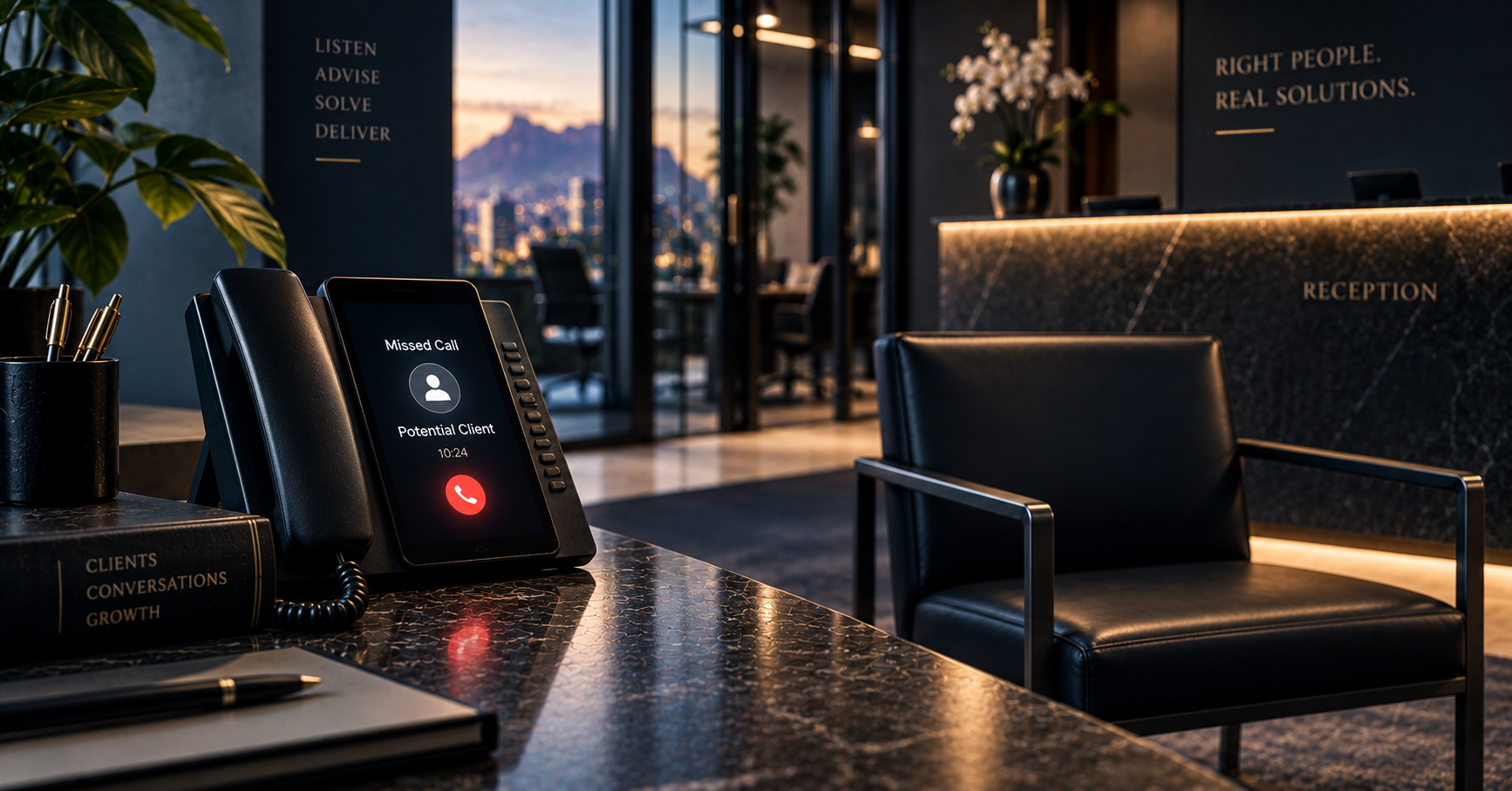
Most people with a legal problem contact three or four firms on the same afternoon. They instruct the one that gets back to them first with a clear, human reply. Skill and reputation matter later, in the consultation. Speed decides who gets the consultation at all.
That is uncomfortable, because it means a firm with weaker credentials than yours can take work off your desk simply by picking up the phone.
How long do people wait before they call the next law firm?
Not long. In our own audits of South African firms, the people who enquire online say they move to the next name within a few hours if nobody replies, and the same evening if the matter is urgent. A missed call after five is usually a lost matter.
Think about who is calling. Someone who has just been retrenched. A parent who has been served with papers. A driver whose bakkie is written off and whose insurer is stalling. They are anxious and they are shopping, whether they admit it or not. Every minute of silence reads as disinterest.
Why does response time matter more than reputation for new enquiries?
Because the caller has no way to judge your legal ability yet. They cannot read your pleadings. So they judge you on the only evidence they have: how you treat them in the first hour.
A fast, plain reply tells them the firm is organised and the matter will be handled. A voicemail box that is full tells them the opposite. Fair or not, that first hour is treated as a preview of the whole relationship.
This is also why cheap tricks backfire. An auto-reply that says "your enquiry is important to us" with no name and no time commitment does nothing. A short message that says who will call and when does the work.
Where do law firm enquiries actually get lost?
Almost never at the front. They get lost in the handover. The phone is answered but the note never reaches the attorney. The website form goes to an info@ address nobody owns. The WhatsApp comes in at half past seven and is read on Thursday.
The usual leaks we find:
- Rings-out numbers. Nobody counts missed calls, so nobody knows the number. Most firms are shocked when they see a month of call logs.
- Shared inboxes. Three people can see the enquiry, which means nobody is responsible for it.
- Website forms with no owner. The mail arrives, gets opened on a phone, and is gone by lunch.
- WhatsApp on a personal number. Fine until that person is in court, on leave, or resigns.
- No after-hours plan. Roughly a third of enquiries land outside office hours, when people finally have time to deal with their problem.
None of this is laziness. It is a system gap, and it is fixable in a week.
What is a realistic response standard for a small firm?
One hour during working hours, and before nine the next morning for anything that arrives at night or over a weekend. That is achievable for a two-person practice without hiring anybody.
Note what the standard is not. It is not legal advice in an hour. It is an acknowledgement in an hour: who you are, that the enquiry has been received, and exactly when a real person will make contact. The advice happens in the consultation, where it belongs.
Write the standard down and tell the whole office. A standard that lives in someone's head is not a standard.
How do you set up fast intake without hiring more staff?
Five things, in this order. None of them cost much and all of them run on a phone.
- Missed-call text-back. Any unanswered call triggers an immediate WhatsApp or SMS: "Thanks for calling Ndlovu Attorneys. We're in consultations until 15:00. Zanele will call you back before 16:30." This single change recovers more matters than any advertising we have run.
- One named owner per channel. The website form goes to one person's phone, not an alias. Same for the WhatsApp Business number and the main line. Name a backup for court days.
- WhatsApp Business with quick replies. Most South Africans would rather type than talk. Set up saved replies for after hours, for document lists, and for directions to the office.
- An urgency rule. Decide in advance what gets escalated: bail, urgent applications, retrenchments with a deadline, serious injury. Everything else gets the standard promise, kept.
- Count for one month. Every enquiry, the source, the time to first reply, and whether it became a consultation. You cannot improve a number you have never looked at.
A firm in Pietermaritzburg we worked with ran the count and found 41 enquiries in a month, 12 of them never answered at all. Nothing about their marketing was broken. Their phones were.
Does fast follow-up breach the Legal Practice Council rules?
No. Answering somebody who contacted you first is not touting. The LPC advertising rules let you market your practice and respond to enquiries, as long as what you say is accurate, not misleading, and does not promise outcomes.
The lines to respect are the obvious ones: no guaranteed results, no pressure on a vulnerable person, no claiming a speciality you do not hold, and no approaching accident victims who never asked to hear from you. A courteous reply to an incoming enquiry sits nowhere near those lines.
How do you know your intake is working?
Track three numbers monthly: missed calls, average time to first response, and the share of enquiries that turn into consultations. Most firms start somewhere near half of enquiries never getting a same-day reply, and a booking rate they have never measured.
Improve the response time and the booking rate moves within a month, with no extra spend on marketing. It is the cheapest growth available to a South African firm right now, which is why we start here on nearly every account. Our Practice Matrix pages bring the enquiries in; intake decides how many become clients.
FAQ
How fast should a law firm reply to a website enquiry? Within an hour during business hours, and by nine the next morning for after-hours enquiries. The first reply only needs to confirm receipt and give a time for a proper call.
Is an automated WhatsApp reply unprofessional? Not if it is specific and honest. Use the firm's name, say why nobody can talk right now, and commit to a callback time that you keep. Vague auto-replies are worse than none.
What percentage of law firm enquiries come in after hours? In the accounts we monitor, roughly a third arrive outside 08:00 to 17:00, with a spike on Sunday evenings. Those enquiries are the easiest to win, because most firms ignore them until Monday.
Should a small firm use an answering service? Only after the free fixes are in place. Missed-call text-back, one named owner per channel, and a written standard usually solve the problem without a monthly fee.
How do I measure intake without new software? A shared spreadsheet with five columns: date, name, source, time of first reply, outcome. One month of honest entries tells you more than any dashboard.
The short version
You do not need better marketing to win more matters this month. You need to answer. Set the standard, name the owner, switch on missed-call text-back, and count what happens.
Counting your enquiries covers the intake half. For the visibility half, our free visibility audit shows where your firm stands on Maps, reviews and the AI answers, and which firms are being found instead.
Written by
Brad McMahon
Ready to see where you stand?
Get your free Google Maps visibility audit for your firm. Delivered in 24 hours.
Get your free visibility audit →