
5 Signs Your Law Firm Website Is a Liability
Want our law-firm growth insights surfaced first in your Google results? Make us a preferred source:
Add as a preferred source on Google
TL;DR
By 2026, law firms must move beyond 'digital boutiques' to The Growth Engine or Systematic Practice Framework. Most websites are currently liabilities that lose money. A digital audit identifies friction and fixes the 'silent killers' of conversion.
Is Your Law Firm Website a Liability?
The legal market is changing fast. For years, a simple website served as a digital brochure. That is no longer enough. By 2026, the gap between basic sites and high-octane lead engines will widen. This gap will decide which firms grow and which firms fade away.
Many law firm owners think a pretty site is a good site. This is a mistake. At Law Firm Growth Agency, we see firms lose revenue every day. Their sites aren't built for results. If your marketing doesn't lead to signed retainers, it is failing. Your website is likely a liability that costs more than it earns. You need a site that acts as a systematic tool for growth. This requires a shift in how you view your online presence. It is not an art project; it is your firm's most vital employee.
Key Takeaway: By 2026, a law firm's site must be a lead engine because 'good enough' has become a risk to the firm's survival.
The Danger of Missing Value Propositions

We often find 'silent killers' during a Result-First Digital Audit. The biggest one is a missing value proposition. This is the message 'above the fold' that tells a visitor what you do. Many lawyers use this space for generic photos of city skylines or law books.
A prospect in crisis doesn't care about a skyline. They want to know if you can solve their problem. If they don't see a solution in three seconds, they leave. They will click the back button and find a competitor. Your website must answer 'What is in it for me?' immediately. If it doesn't, your site is just an expensive digital brochure. You are paying for traffic that never turns into a lead. This is why a digital audit is vital to catch these simple but costly errors.
Key Takeaway: If a prospect doesn't see how you solve their problem in three seconds, they will leave your site immediately.
Is Your Intake Process Too Hard for Clients?
High-friction intake is a major flaw. It causes websites to lose the few leads they actually get. Some firms still use forms with fifteen different fields. Others make people dial a phone number that isn't clickable on a mobile device.
When someone is stressed, they won't jump through hoops. These old methods push qualified leads away. We recommend logic-based funnels instead. These funnels qualify leads in real-time. They make the path to a consultation very easy. A digital audit often shows that simplifying a form can double a firm's leads overnight. You want to remove every possible hurdle. Every extra click is a chance for a lead to quit. Modern users expect a seamless experience on every device. If you don't provide it, they will find someone who does.
Key Takeaway: Long forms and non-clickable numbers drive away good leads; use logic-based funnels to simplify the path to a consultation.
Why You Need Proof-of-Life Assets
Most sites list awards and associations. This is not enough. You need 'proof-of-life' assets. These are verified case results and social proof that match a client's specific pain.
A 'high-octane lead engine' uses results to build trust. Prospects want to see that you have won cases just like theirs. If you hide your wins, your site stays a digital brochure. You become a commodity rather than a credible solution. Trust markers must be easy to find. They should be woven into every page of the site. Without this proof, your conversion rates will stay low. People need to feel safe before they hire a lawyer. Verified results are the best way to create that safety. If your site lacks these, you are leaving money on the table every month.
Key Takeaway: Verified case results and specific social proof are necessary to turn a site into a credible solution provider.
Stop Tracking Vanity Metrics That Don't Pay
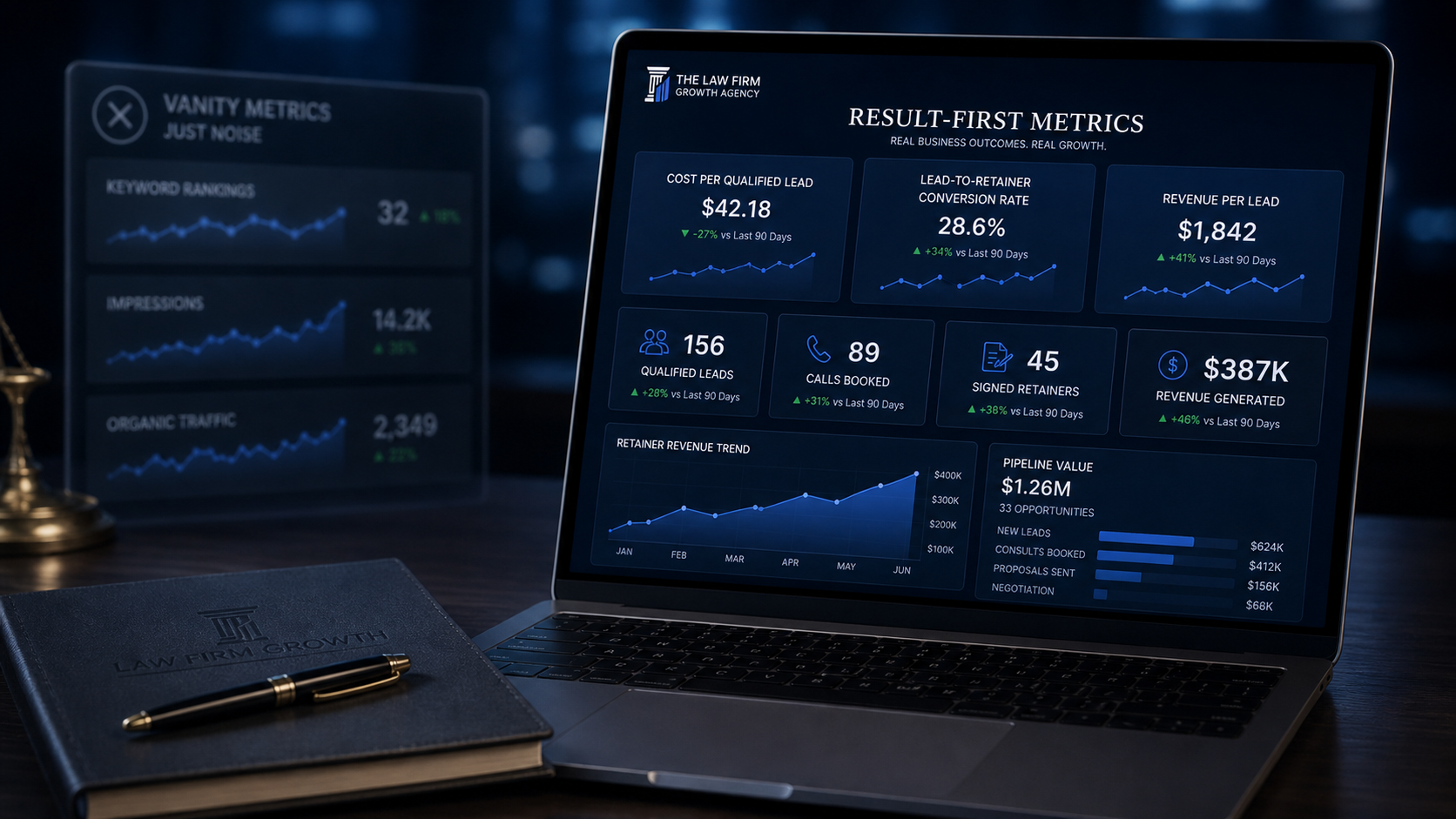
Many firms track the wrong numbers. They look at keyword rankings and site impressions. These are vanity metrics. They feel good but don't pay the bills. You cannot pay your staff with organic traffic.
A Result-First Digital Audit focuses on metrics that matter. We look at the cost per qualified lead. We track the lead-to-retainer conversion rate. If your marketing doesn't result in a signed contract, it is just noise. It is not an investment; it is an expense. Many agencies hide behind fancy reports full of big numbers that mean nothing for your bank account. Stop being satisfied with views. Start demanding data that shows a return on your spend. High-performing firms know exactly what a client costs to acquire. If you don't know that number, your marketing is out of control.
Key Takeaway: Prioritize 'Result-First' metrics like cost per lead and revenue per lead instead of just looking at traffic.
Does Your Website Look Good but Fail to Work?
We see a constant fight between beauty and results. Many law firm partners love the 'museum aesthetic.' This means lots of white space and minimal text. It looks prestigious on a laptop in a boardroom.
However, this design creates friction for a client in a crisis. A person who needs a lawyer right now isn't looking for an art gallery. They want answers and a phone number. Minimalist designs often hide the intake forms. When a visitor has to hunt for a way to contact you, they leave. Your website is a tool for lead generation, not a trophy. The 2026 blueprint requires fast load times and bold calls to action. You can keep your reputation while getting better results. You just have to stop putting ego over intake data. A digital audit will show exactly where your 'elegant' design is losing you money. Your website should be a high-octane engine for growth, not a static image.
Key Takeaway: Prioritising a 'museum aesthetic' over clear conversion paths sabotages your ROI and pushes clients to competitors.
Conclusion
The shift from a passive digital brochure to a high-octane lead engine is a requirement for firms aiming for dominance. The legal market moves fast. If you delay, you'll be left behind. These five signs are urgent calls to action for any serious law firm.
Ignoring these leaks leads to high costs and stagnant growth. Your website shouldn't be a financial drain. Stop choosing ego over intake data. It is time to demand a real return on investment from your digital presence. Turn your site from a liability into a powerhouse. Your firm's future growth depends on the systems you build today.
Stop the bleeding now. Schedule a high-octane Digital Audit and start building a systematic engine for growth.
Key Definitions
High-Octane Lead Engine
A systematic conversion funnel built on data that uses aggressive landing page optimisation and automated intake to drive signed retainers.
Result-First Digital Audit
A strategic review of digital assets focused on finding conversion bottlenecks and optimizing for ROI rather than vanity metrics.
Museum Aesthetic
The design philosophy that prioritises empty white space and prestigious imagery over clear calls to action and lead generation.
Proof-of-Life Conversion Assets
Verifiable evidence such as case results and client testimonials that prove a law firm can solve specific legal problems.
Silent Killers
Specific website flaws like missing value propositions or complex forms that drive potential clients away without the firm realizing it.
Frequently Asked Questions
What is a high-octane lead engine?
It is a data-driven system built for one purpose: signing new clients. It uses targeted capture and fast intake to turn visitors into retainers.
Why are standard SEO metrics a liability?
Vanity metrics like clicks and rankings don't pay the bills. A firm needs to track the cost per qualified lead and revenue per lead to see true growth.
What are the 'silent killers' on law firm websites?
Common killers include high-friction forms, a lack of clear value above the fold, and a lack of proof through verified case results.
How does a 'museum aesthetic' hurt my firm?
This style focuses on looking pretty rather than working. It hides contact info behind 'elegant' layers, which frustrates people who need a lawyer fast.
What happens if my firm doesn't change by 2026?
Firms that fail to adapt will see their client acquisition costs triple as competitors use smarter, faster engines to take the best leads.
Keywords
Law Firm Marketing
Lead Generation
Digital Audit
Lawyer SEO
Legal Business Growth
Written by
Brad McMahon
Ready to see where you stand?
Get your free Google Maps visibility audit for your firm. Delivered in 24 hours.
Get your free visibility audit →