
SEO vs. AEO for Family Law Firms: A Comparative Study
Want our law-firm growth insights surfaced first in your Google results? Make us a preferred source:
Add as a preferred source on Google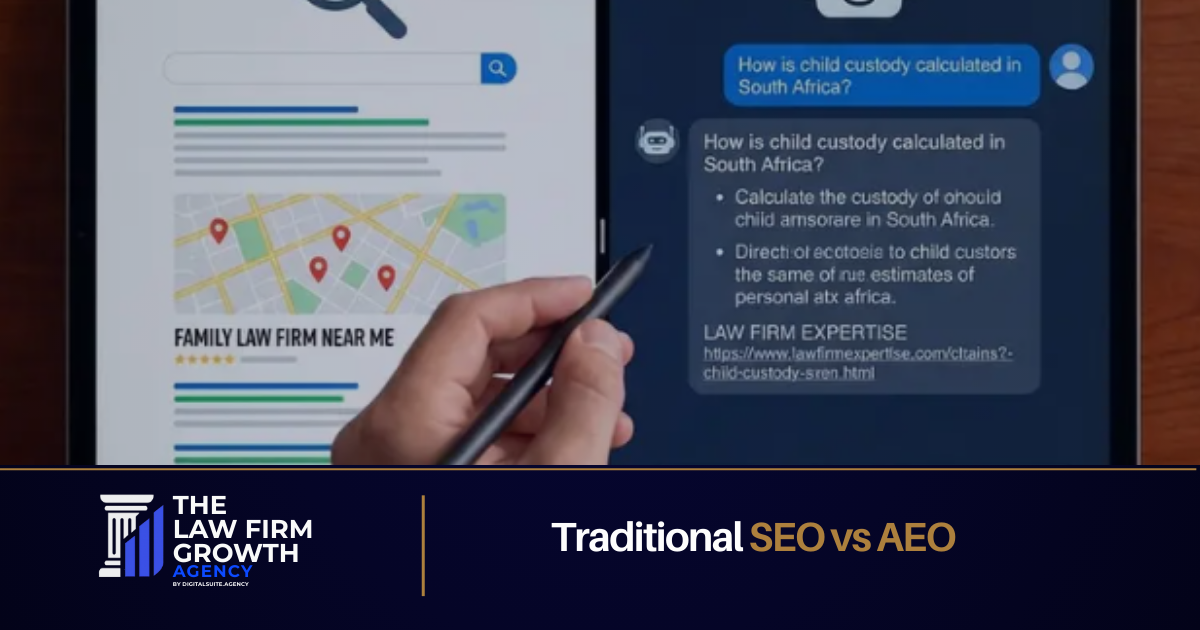
TL;DR: Family law firms face a choice between traditional SEO and emerging AEO (Answer Engine Optimization). The data shows SEO still drives strong local conversions but click-through rates dropped 64% in one year. AEO captures 85 million daily queries before people search Google, with early adopters seeing 3.4x more traffic. The answer: you need both. SEO builds the authority foundation. AEO amplifies reach across AI platforms. Integration creates compounding visibility.
SEO vs. AEO: Quick Comparison
SEO dominates local visibility (75% of users engage only with top 3 Google Maps results)
AEO captures pre-search behaviour (800M weekly ChatGPT users asking legal questions)
SEO offers proven measurement; AEO tracking is still immature
Content optimized for both gets cited 3x more by AI while maintaining Google rankings
Integration model: SEO builds foundation, AEO multiplies reach
The landscape has split into two channels over the past 18 months. Traditional SEO still drives traffic. Answer Engine Optimization now captures a growing share of decision-critical queries.
The question isn't which one to choose. It's how they work together.
Here's what the data shows.
Understanding the Two Approaches
Search Engine Optimization (SEO) focuses on ranking your website in traditional search results — Google, Bing, and other search engines. It's about appearing when someone types a query and clicks through result pages.
Answer Engine Optimization (AEO) structures your content so AI systems like ChatGPT, Perplexity, and Google's AI Overviews can extract and cite your expertise directly in their answers — often before a user clicks anything.
Both target visibility. But they intercept prospects at different points in the decision journey.
SEO for Family Law: Strengths and Limitations
Where SEO Still Dominates
Local visibility remains unmatched. 75% of users only engage with the top three local pack results in Google Maps. For family law firms, local isn't optional — it's the primary conversion channel. Organic search generates 66% of call conversions in the legal sector, with a conversion rate of over 4%.
Proven infrastructure. The mechanisms work. Backlinks, on-page optimization, Google Business Profile management, and review generation have clear cause-and-effect relationships with rankings and traffic.
Measurement maturity. Analytics tools are sophisticated. You can track rankings, traffic sources, conversion paths, and ROI with precision.
Established trust signals. 82% of people check reviews when looking for legal services. 40% say it influences their choice of law firm. SEO integrates these trust signals into the visibility architecture.
Where SEO Is Losing Ground
Click-through rates are collapsing. Between March 2024 and March 2025, the average click-through rate for a #1 ranking dropped from 0.73 to 0.26 — a 64% reduction for the exact same position. Nearly 60% of Google searches now end without a single click.
Zero-click searches are the new normal. Prospects get their answers directly from AI Overviews, featured snippets, and knowledge panels without visiting your site (even if you rank well).
Traditional search volume is declining. Gartner predicts that by 2026, traditional search engine volume will drop 25% due to AI chatbots and virtual agents. This isn't speculation — it's structural reallocation of attention.
AEO for Family Law: Strengths and Limitations
Where AEO Creates New Advantages
Captures pre-search behaviour. ChatGPT reached 800 million weekly active users by October 2025. That's approximately 85 million daily queries happening before prospects ever search Google. Questions like "How is child custody calculated in South Africa?" and "Do I need a lawyer for a custody modification?" are being answered by AI first.
3.4x traffic multiplier for early adopters. Companies that established dedicated AEO strategies in early 2024 report capturing 3.4x more answer engine traffic compared to competitors who delayed implementation. This isn't incremental — it's exponential.
Appears in high-intent problem-solving queries. Google AI Overviews now appear in approximately 30% of all searches and 74% of problem-solving queries. Family law is fundamentally problem-solving: divorce process questions, custody concerns, asset division clarity.
Content formatted for LLM extraction gets cited 3x more often. When your content is structured for AI comprehension — clear questions, direct answers, schema markup — it becomes 3 times more likely to be cited by AI systems.
Where AEO Falls Short
Measurement is immature. Unlike SEO, there's no established analytics infrastructure for tracking answer engine citations. You can't log into a dashboard and see your "AEO rankings."
No direct control over citations. With SEO, you control your content and can predict outcomes. With AEO, AI systems decide whether to cite you. You can optimize for it, but you can't guarantee it.
Requires content restructuring. Most existing legal content isn't formatted for AI extraction. Blog posts need to be rewritten. FAQ pages need schema markup. Practice area descriptions need conversational restructuring.
Attribution is unclear. When someone calls after reading an AI-generated answer that cited your firm, you may not know the source. Traditional conversion tracking doesn't capture this channel well.
The Family Law Context: Why This Market Is Different
Family law sits at a unique intersection that makes both approaches essential.
Nearly half of family law prospects choose an attorney within three days of starting their online search. The decision window is narrow. Speed matters. 80% of consumers say being searchable online positively influences their lawyer choice. But "searchable" now means appearing in both traditional results and AI-generated answers.
Here’s the paradox: 40% of family law seekers don't want AI technology involved in their case. 72% prefer traditional phone calls. But they're using AI to decide who deserves that phone call. Your clients are digitally searching but emotionally traditional. They want human connection — after filtering their options through machine-generated answers.
The Integration Model: Why You Need Both
The firms gaining visibility aren't choosing between SEO and AEO. They're integrating both into a unified architecture.
SEO builds the foundation. You need domain authority, backlinks, local rankings, and Google Business Profile optimization. Without this foundation, AI systems have less reason to cite you. There's a 0.65 linear correlation between a website's authority and frequency in AI citations.
AEO amplifies the foundation. Once you have authority, structuring your content for AI extraction multiplies its reach. The same blog post that ranks in Google also gets cited in ChatGPT responses and appears in Perplexity results.
Schema markup becomes the translation layer. Legal websites with structured data experience 20-30% improvements in click-through rate. For AI systems, schema translates human-readable content into machine-parseable authority signals. LegalService schema, FAQ schema, and LocalBusiness schema aren't optional anymore.
E-E-A-T works for both channels. Experience, Expertise, Authoritativeness, and Trust aren't just SEO guidelines — they're algorithmic infrastructure for both traditional and answer engine visibility.
What This Means Practically
Most family law firms already have the content foundation. What needs to change is format and structure.
Question-based content becomes dual-purpose. It serves human readers and AI parsers simultaneously. Clear questions. Direct answers. Structured format.
Conversational language becomes a ranking signal. AI systems are trained on natural human dialogue. Formal legal language gets bypassed. Accessible explanations get cited.
Content freshness becomes a trust signal. Outdated information erodes authority in both channels. Regular updates signal active expertise.
Decision-focused content outperforms marketing content. Prospects don't want to be sold. They want clarity on their options, timelines, and next steps. Both SEO and AEO reward this approach.
Conclusion: Integration, Not Replacement
The data is clear: SEO and AEO aren't competing strategies. They're complementary layers in a visibility architecture.
Traditional SEO remains essential for local visibility, conversion tracking, and established trust signals. But without AEO, you're invisible in the growing channel where prospects ask their first questions.
Answer Engine Optimization captures pre-search behaviour and high-intent problem-solving queries. But without SEO's authority foundation, AI systems have less reason to cite you.
The firms that integrate both create compounding visibility. They appear in Google Maps, AI Overviews, and ChatGPT responses simultaneously. That's not luck — it's architecture. Real growth doesn't happen by accident. It's engineered. And right now, the engineering requirements include both.
Written by
Brad McMahon
Ready to see where you stand?
Get your free Google Maps visibility audit for your firm. Delivered in 24 hours.
Get your free visibility audit →