
How I Measure Marketing When Trust Matters More Than Traffic
Want our law-firm growth insights surfaced first in your Google results? Make us a preferred source:
Add as a preferred source on Google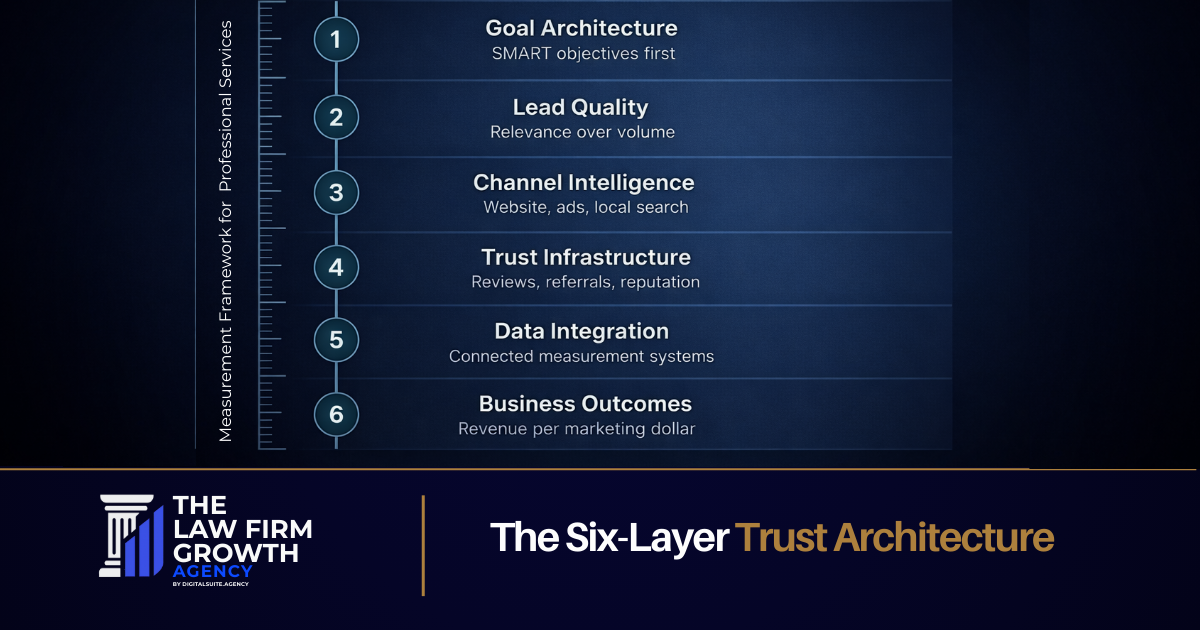
TL;DR: Most professional service firms measure the wrong things. They track traffic and clicks while trust and client acquisition go unmeasured. This framework shows you how to measure what drives revenue: lead quality, trust signals, and business outcomes.
Core Framework:
Set SMART goals that connect to revenue, not vanity metrics
Measure lead quality over lead volume
Track channel-specific trust signals
Integrate data across platforms to see the full client journey
Connect marketing activity directly to client acquisition costs and lifetime value
Professional service firms face a measurement problem.
You invest in websites, run ads, post content. But when someone asks if it's working, the answer sounds like guesswork. The problem isn't effort. It's measurement architecture.
It’s easy to track what's easy to see—website visits, social media likes, email open rates. These numbers feel productive. They, by nature, go up so they create the illusion of momentum. But they don't answer the question that actually determines survival: Are we acquiring clients who trust us enough to hire us?
In professional services, that question is everything. Legal firms, medical practices, financial advisors, real estate professionals—you all operate in emotionally sensitive situations where trust isn't a nice-to-have. It's the entire transaction. And trust can't be measured by impressions.
So I built a framework that professional service firms can actually use. Not theory. Not aspiration. A systematic approach to measuring what matters when your clients need to believe in you before they'll even consider working with you.
The Measurement Crisis Nobody Talks About
Here's what the data shows: two-thirds of marketing leaders report significant challenges demonstrating marketing impact to stakeholders.
Two-thirds!!
That's not a skills gap. That's a structural problem.
The tools most firms use were built for e-commerce businesses selling products to strangers. Quick decisions. Impulse purchases. High volume, low consideration. Professional services operate in the opposite universe. Your clients research for weeks or months. They ask colleagues for referrals. They read reviews obsessively. They evaluate your expertise, your credibility, your values. And then —maybe—they reach out.
Measuring that journey with e-commerce metrics is like using a thermometer to measure distance. The tool works. It's just measuring the wrong thing.
What Professional Services Should Actually Measure
I structure measurement around six connected layers. Each one reveals something different about whether your marketing is building the trust infrastructure that converts strangers into clients.
Layer 1: Goal Architecture
Most firms set goals that sound strategic but measure nothing useful. "Increase brand awareness." "Improve online presence." "Generate more leads." These aren't goals. They're wishes.
I use SMART goals because they force precision. Specific. Measurable. Achievable. Relevant. Time-bound.
Here's the difference:
Vague goal: "Get more clients from our website."
SMART goal: "Generate 15 qualified consultation requests per month from organic search traffic within 90 days, targeting clients in our service area with cases we specialize in."
The second version tells you exactly what to measure, what success looks like, and whether your marketing infrastructure is working.
Layer 2: Lead Quality Over Lead Quantity
I learned this the hard way. Early in my career, I optimized for volume. More traffic. More inquiries. More everything. The numbers looked great, but the business results didn't.
Because 100 unqualified leads create more work than 10 qualified ones. They consume time. They drain resources. They make you feel busy while your revenue stays flat.
Professional services need a different filter. I measure:
Inquiry relevance: Does this person need what we actually provide?
Financial qualification: Can they afford our services?
Decision timeline: Are they ready to move forward, or just exploring?
Geographic fit: Are they in our service area?
One qualified consultation request is worth more than 50 tire-kickers. The data backs this up. In legal marketing, click-through rates average 4.76%, but conversion rates determine everything. You're not optimizing for clicks. You're optimizing for clients who hire you.
Layer 3: Channel-Specific Intelligence
Different marketing channels reveal different types of trust signals. Your website shows whether people find you credible enough to explore further. Paid advertising tests whether your positioning resonates with the right audience. Local search proves whether your community knows you exist.
I track each channel separately because they answer different questions:
Website metrics:
Time on key pages (service descriptions, about page, case studies)
Bounce rate on landing pages
Conversion paths from entry to contact
Paid advertising:
Cost per qualified lead
Conversion rate by ad message
Return on ad spend for client acquisition
Local search:
Google Business Profile views and actions
Direction requests
Phone calls from search
Here's what surprised me: for professional services, proximity drives 58.6% of local search rankings overall, but for top positions, review volume dominates at 38.6%. That means local visibility requires two simultaneous strategies—geographic optimization and systematic review generation. Most firms only do one.
Layer 4: Trust as Measurable Infrastructure
This is where most measurement frameworks fall apart. They track behaviour but ignore belief.
Professional service clients don't just need to find you… They need to trust you. And trust leaves measurable signals:
Review volume and sentiment: Are clients recommending you publicly?
Referral rates: What percentage of new clients come from existing relationships?
Repeat engagement: Do clients return for additional services?
Net Promoter Score: Would clients actively promote you to others?
The research is clear: 83% of consumers prefer brands they trust, and 71% would abandon a brand after a trust breach. In professional services, where clients are navigating legal crises, medical decisions, or financial planning, trust isn't philosophical. It's the entire competitive advantage.
I measure it systematically.
Layer 5: Data Integration
Here's the problem most firms face: their marketing data lives in seven different places. Website analytics in one platform. CRM data in another. Advertising metrics in a third. Email performance somewhere else. You can't measure what you can't see holistically.
The data proves this: 55% of marketers believe poorly integrated data environments have caused revenue loss, and 34% of CMOs don't trust their own data.
Build your integration architecture first. Before optimising anything, make sure all the systems talk to each other. Otherwise, you're measuring fragments instead of the full client journey.
Layer 6: Business Outcomes
This is where measurement becomes revenue. Everything else is diagnostic. This layer is definitive.
Track:
Cost per acquisition: What does it cost to acquire one new client?
Client lifetime value: How much revenue does each client generate over time?
Marketing ROI: For every dollar invested, how much comes back?
Professional services should target 3:1 to 5:1 ROI—300% to 500% return—because of high-value services, longer decision cycles, and referral-based growth patterns.
If your measurement framework can't connect marketing activity to these outcomes, you're tracking motion instead of momentum.
The Shift From Intuition to Evidence
Professional services have operated on intuition for decades. "We think the website is working." "Our ads seem to be generating interest." "People probably find us through referrals." That approach worked when competition was local and clients had fewer options. It doesn't work anymore.
The market has professionalized. Clients research online before they ever contact you. Your competitors are measuring what works and doubling down on it. And the firms that can prove ROI get the budget to scale while others stay stuck.
What I've Learned Building This
Measurement isn't about perfection. It's about clarity. You don't need to track everything. You need to track what reveals whether your marketing is building trust infrastructure that converts. Start with one layer. Get it right. Then add the next.
Most firms try to implement everything at once and end up with data they don't understand and can't act on. That's worse than no measurement at all.
Professional services need marketing that educates and converts simultaneously. You're not selling products. You're building relationships with people who need to believe in your expertise before they'll trust you with their problems. That requires different architecture.
And when you measure it correctly, growth stops feeling random and starts feeling systematic.
Key Takeaways
Professional service marketing requires measuring trust and client acquisition, not just traffic and engagement metrics
SMART goals connect marketing activity to specific revenue outcomes within defined timeframes
One qualified lead who hires you is worth more than 50 unqualified inquiries
For local professional services, review volume drives 38.6% of top search rankings, making systematic review generation a competitive advantage
Integration across platforms reveals the full client journey. Fragmented data creates blind spots that cost you revenue
Target 3:1 to 5:1 marketing ROI for professional services because of high-value clients and referral-based growth patterns
Start with one measurement layer, get it right, then add the next. Trying to measure everything at once creates data you can't act on
Written by
Brad McMahon
Ready to see where you stand?
Get your free Google Maps visibility audit for your firm. Delivered in 24 hours.
Get your free visibility audit →